MCQ
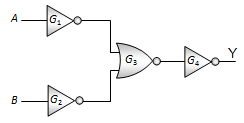
The combination of gates shown below produces
  • A
    $\text{AND}$ gate
  • B
    $\text{XOR}$ gate
  • C
    $\text{NOR}$ gate
  • $\text{NAND}$ gate 

Answer

Correct option: D.
$\text{NAND}$ gate 
$\text{NAND}$ gate 

Need a full question paper?

Generate a complete, print-ready paper with questions like this in minutes — across 16+ boards, with answer keys.

Start Generating Free

Similar questions

Consider telecommunication through optical fibres.  Which of the following statements is not true(a) Optical fibres may have homogeneous core with a suitable cladding (b) Optical fibres can be of graded refractive index(c) Optical fibres are subject to electromagnetic interference from outside (d) Optical fibres have extremely low transmission loss


The phenomenon of interference is shown by(a) Longitudinal mechanical waves only(b) Transverse mechanical waves only(c) Electromagnetic waves only(d) All the above types of waves
   
   
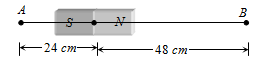
A bar magnet of length $3 \ cm$ has points $A$ and $B$ along its axis at distances of $24 \ cm$ and $48 \ cm$ on the opposite sides. Ratio of magnetic fields at these points will be
A voltmeter having resistance of $50 \times 10^3 \text{ohm}$ is used to measure the voltage in a circuit. To increase the range of measurement $3$ times the additional series resistance required is
In a parallel plate condenser, the radius of each circular plate is $12 \ cm$ and the distance between the plates is $5\ mm.$ There is a glass slab of $3\ mm$ thick and of radius $12 \ cm$ with dielectric constant $6$ between its plates. The capacity of the condenser will be
A Solid sphare of radius $R$ has a charge $Q$ distributed in its Volume with a charge density $P = Kr^a$ Where $K$ and a are constants and r is the distance from its centre from its centre. if the electric filed at $\text{r}=\frac{\text{R}}{2}$ is $\frac{1}{8}$ times that at $r = R,$ the value of a is.
Which among the following shows the particle nature of light?
The focal length of a concave mirror is $f$ and the distance from the object to the principle focus is $x.$ The ratio of the size of the image to the size of the object is
Which of the following (referred to a spherical mirror) do (does) not depend on whether the rays are paraxial or not?
In an electron gun the control grid is given a negative potential relative to cathode in order to: