MCQ
The complex cation which has two isomers is:
  • A
    $\left[ Co \left( H _2 O \right)_6\right]^{3+}$
  • B
    $\left[ Co \left( NH _3\right)_5 Cl \right]^{2+}$
  • $\left[ Co \left( NH _3\right)_5 NO _2\right]^{2+}$
  • D
    $\left[ Co \left( NH _3\right)_5 Cl \right]^{+}$
Answer

Correct option: C.
$\left[ Co \left( NH _3\right)_5 NO _2\right]^{2+}$
c
$\left(\left[ Co \left( NH _3\right)_5 NO _2\right]^{2+}\right.$

Two linkage isomers possible $NO _2 \rightarrow$ Ambidentate ligand

Need a full question paper?

Generate a complete, print-ready paper with questions like this in minutes — across 16+ boards, with answer keys.

Start Generating Free

Similar questions

The osmotic pressure of a dilute solution is directly proportional to the
Under normal condition which of the following electronic configuration is able to form dipositive ion
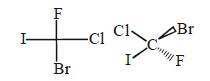
What is relation between following molecules
$A ( g ) \rightleftharpoons 2 B ( g )+ C ( g )$

For the given reaction, if the initial pressure is $450\,mm Hg$ and the pressure at time $t$ is $720\,mm\,Hg$ at a constant temperature $T$ and constant volume $V$. The fraction of $A ( g )$ decomposed under these conditions is $x \times 10^{-1}$. The value of $x$ is $......$.(nearest integer)

Which of the following order is incorrect ?
The electrons, identified by quantum by numbers $n$ and $l,$ $(i)\, n = 4, l = 1$ $(ii)\, n = 4, l= 0$ $(iii)\, n = 3, l= 2$ $(iv)\,n = 3, l = 1$ can be placed in order of increasing energy, from the lowest to highest, as
For the reaction, $2N_2O_5(g) \to 4NO_2(g) + O_2(g)$ , the rate of formation of $O_2$ is $0.032\,g\,h^{-1}$ , then rate of conversion of $N_2O_5$ in $g\,h^{-1}$ is
Methyl-terbutyl ether on heating with $HI$ of one molar concentration gives
The correct order of increasing $s$ -character (in percentage) in the hybrid orbitals of following molecules ions is :-
$(I)$ $CO_3^{2-}$                  $(II)$ $XeF_4$
$(III)$ $I_3^-$                       $(IV)$ $NCl_3$
$(V)$ $BeCl_2$
The equivalent conductances of two strong electrolytes at infinite dilution in $H_2O$ (where ions move freely through a solution) at $25^o C$ are given below : 

$\Lambda _{C{H_3}COONa}^o =91.0\, S \,cm^2 /equiv.$

$\Lambda _{HCl}^o =426.2 \,S \,cm^2 /equiv.$

What additional information$/$quantity one needs to calculate ${\Lambda ^o}$ of an aqueous solution of acetic acid ?