MCQ
The complex cation which has two isomers is:
  • A
    $\left[ Co \left( H _2 O \right)_6\right]^{3+}$
  • B
    $\left[ Co \left( NH _3\right)_5 Cl \right]^{2+}$
  • $\left[ Co \left( NH _3\right)_5 NO _2\right]^{2+}$
  • D
    $\left[ Co \left( NH _3\right)_5 Cl \right]^{+}$

Answer

Correct option: C.
$\left[ Co \left( NH _3\right)_5 NO _2\right]^{2+}$
c
$\left(\left[ Co \left( NH _3\right)_5 NO _2\right]^{2+}\right.$

Two linkage isomers possible $NO _2 \rightarrow$ Ambidentate ligand

Need a full question paper?

Generate a complete, print-ready paper with questions like this in minutes — across 16+ boards, with answer keys.

Start Generating Free

Similar questions

Acidic property of phenol can be explained when it is reacted with
For the following reactions

$\mathrm{CH}_{3} \mathrm{CH}_{2} \mathrm{CH}_{2} \mathrm{Br}+\mathrm{Z}^{-}$$\xrightarrow[{{\text{Sublimation}}}]{{{k_s}}} \mathrm{CH}_{3} \mathrm{CH}_{2} \mathrm{CH}_{2} \mathrm{Z}+\mathrm{Br}^{-}$

$\mathrm{CH}_{3} \mathrm{CH}_{2} \mathrm{CH}_{2} \mathrm{Br}+\mathrm{Z}^{-}$$\xrightarrow[{{\text{elimination}}}]{{{k_e}}}\mathrm{CH}_{3} \mathrm{CH}= \mathrm{CH}_{2} +\mathrm{HZ}+\mathrm{Br}^{-}$

where 

$\mathrm{Z}^{-}=\mathrm{CH}_{3} \mathrm{CH}_{2} \mathrm{O}^{-}(\mathrm{A})$ or $\begin{array}{*{20}{c}}
  {\,C{H_3}} \\ 
  {|\,\,\,\,\,} \\ 
  {C{H_3} - C - {O^ - }(B)} \\ 
  {|\,\,\,\,} \\ 
  {\,\,C{H_3}} 
\end{array}$

$\mathrm{k}_{\mathrm{s}}$ and $\mathrm{k}_{\mathrm{e}},$ are $,$ respectively, the rate constants for the substitution and elimination, and $\mu=\frac{\mathrm{k}_{\mathrm{s}}}{\mathrm{k}_{\mathrm{e}}},$ the correct options is
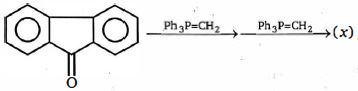
Product $(x)$ is
The conductivity of centimolar solution of $KCl$ at $25^{\circ} C$ is $0.0630 ohm ^{-1} cm^{-1}$ and the resistance of the cell containing the solution at $25^{\circ} C$ is 30 ohm. The value of cell constant is:
Consider the following sequence of $A$ can be

$\underset{{{C}_{3}}{{H}_{6}}C{{l}_{2}}}{\mathop{A}}\,\,\xrightarrow[2.\,\,{{H}^{+}}\,\,(\min d)]{\begin{smallmatrix} 
 1\,.\,\,alcoholic\,\,KOH\,/\,\Delta  \\ 
 followed\,\,by\,\,NaN{{H}_{2}}\,/\,\Delta  
\end{smallmatrix}}$ $B\,\xrightarrow[{{H}_{2}}{{O}_{2}}/\overset{\Theta }{\mathop{O}}\,H]{{{B}_{2}}{{H}_{6}}}C$

$A\,\xrightarrow{aq.\,\,KOH\,(excess)}C$

If interionic distance between  $Na^+$  and  $F^-$  ions is  $2.31\,\mathop A\limits^o $ then radii of  $Na^+$  and   $F^-$  are
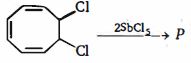
$p$ will be
Which of the following has largest size
$100\, mL$ of a solution contains $0.1\, M \,NH_4OH$ and $0.1\, M \,NH_4Cl$. The $pH$  of the solution will not change on adding :-
An organic compound $\left( C _8 H _{10} O _2\right)$ rotates plane-polarized light. It produces pink color with neutral $FeCl _3$ solution. What is the total number of all the possible isomers for this compound?