MCQ
The component of vector $A = 2\hat i + 3\hat j$ along the vector $\hat i + \hat j$is
  • $\frac{5}{{\sqrt 2 }}$
  • B
    $10\sqrt 2 $
  • C
    $5\sqrt 2 $
  • D
    $5$

Answer

Correct option: A.
$\frac{5}{{\sqrt 2 }}$
a
(a)$\frac{{\overrightarrow A .\overrightarrow B }}{{|\vec i + \vec j|}} = \frac{{(2\hat i + 3\hat j)\,(\hat i + \hat j)}}{{\sqrt 2 }}$$ = \frac{{2 + 3}}{{\sqrt 2 }} = \frac{5}{{\sqrt 2 }}$

Need a full question paper?

Generate a complete, print-ready paper with questions like this in minutes — across 16+ boards, with answer keys.
Start Generating Free

Similar questions

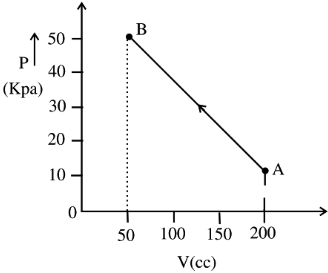
The pressure of a gas changes linearly with volume from $A$ to $B$ as shown in figure. If no heat is supplied to or extracted from the gas then change in the internal energy of the gas will be $............\,J$
$A$ ball whose size is slightly smaller than width of the tube of radius $2.5 \,m$ is projected from bottommost point of a smooth tube fixed in a vertical plane with velocity of $10\, m/s$. If $N_1$ and $N_2$ are the normal reactions exerted by inner side and outer side of the tube on the ball
Roads are banked on curves so that
Four solids are shown in cross section. The sections have equal heights and equal maximum widths. They have the same mass. The one which has the largest rotational inertia about a perpendicular through the centre of mass is 
A ball of mass $160\, g$ is thrown up at an angle of $60^{\circ}$ to the horizontal at a speed of $10 \,m / s$. The angular momentum of the ball at the highest point of the trajectory with respect to the point from which the ball is thrown is nearly $\left(g=10\, m / s ^{2}\right)$ (in $kgm ^{2} / s$)
The velocity- time graph of a body falling from rest under gravity and rebounding from a solid surface is represented by which of the following graphs?
A given mass of a gas is allowed to expand freely until its volume becomes double. If ${C_b}$ and ${C_a}$ are the velocities of sound in this gas before and after expansion respectively, then ${C_a}$ is equal to
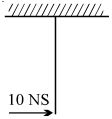
$A$ thin uniform straight rod of mass $2\, kg$ and length $1\, m$ is free to rotate about its upper end when at rest. It receives an impulsive blow of $10\, Ns$ at its lowest point, normal to its length as shown in figure. The kinetic energy of rod just after impact is ........ $J$
For a gas the difference between the two specific heats is $4150\, J/kg\, K.$ What is the specific heats at constant volume of gas if the ratio of specific heat is $1.4$
Which of the following statements are true for wave motion: