MCQ
$Assertion$ : $n$ small balls each of mass $m$ colliding elastically each second on surface with velocity $u$. The force experienced by the surface is $2\,mnu$.

$Reason$ : On elastic collision, the ball rebounds with the same velocity.

  • If both Assertion and Reason are correct and the Reason is a correct explanation of the Assertion.
  • B
    If both Assertion and Reason are correct but Reason is not a correct explanation of the Assertion.
  • C
    If the Assertion is correct but Reason is incorrect.
  • D
    If both the Assertion and Reason are incorrect.
Answer

Correct option: A.
If both Assertion and Reason are correct and the Reason is a correct explanation of the Assertion.
a
In elastic collision, kinetic energy remains conserved therefore the ball rebounds with the same velocity. According to Newton’s second law
$F \times t = $ change in linear momentum.
$\therefore F \times 1 = m \times n\left( {u + u} \right) \Rightarrow F = 2\,mmu$

Need a full question paper?

Generate a complete, print-ready paper with questions like this in minutes — across 16+ boards, with answer keys.

Start Generating Free

Similar questions

$5.6$ liter of helium gas at $STP$ is adiabatically compressed to $0.7$ liter. Taking the initial temperature to be $T _1$, the work done in the process is
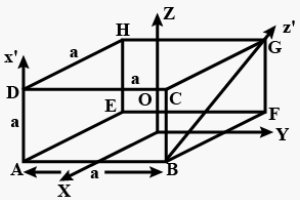
With reference to of a cube of edge a and mass $m,$ state whether the following are true or false. $(O$ is the centre of the cube.$)$
Image
  1. The moment of inertia of cube about $z-$axis is $\text{I}_\text{x}=\text{I}_\text{x}+\text{I}_\text{y}$
  2. The moment of inertia of cube about $z′$ is $\text{I}'_\text{z}=\text{I}_\text{z}+\frac{\text{ma}^2}{2}$
  3. The moment of inertia of cube about $z"$ is $\text{I}{''}_{\text{z}}=\text{I}_2+\frac{\text{ma}^2}{2}$
  4. $\text{I}_\text{x}=\text{I}_\text{y}$
A cord is used to lower vertically a block of mass $M$ by a distance $d$ with constant downward acceleration $\frac{g}{4}$. Work done by the cord on the block is
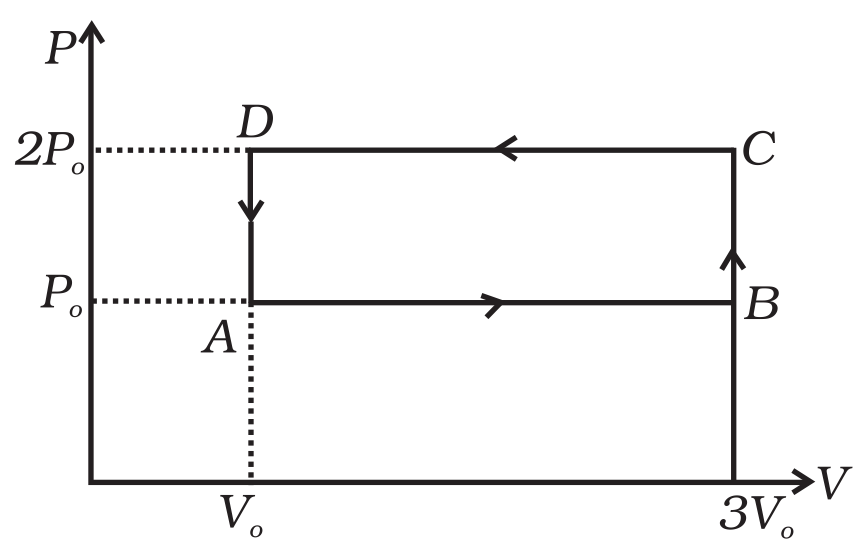
An ideal gas undergoes cyclic process $\text{ABCDA}$ as shown in given $PV$ diagram. The amount of work done by the gas is:
Second harmonic of open pipe is:
A spacecraft of mass $M$ moves with velocity $V$ in free space at first, then it explodes breaking into two pieces. If after explosion a piece of mass $m$ comes to rest, the other piece of spacecraft will have a velocity
$Assertion$ : Space rocket are usually launched in the equatorial line from west to east
$Reason$ : The acceleration due to gravity is minimum at the equator.
Water falls from a tap, down the streamline.
Which force can possibly act on a body moving in a straight line?
Two projectiles are thrown with same initial velocity making an angle of $45^{\circ}$ and $30^{\circ}$ with the horizontal respectively. The ratio of their respective ranges will be.