Question
The components of any vect $A_y$. Then by geometric metod prove that
$
|\overrightarrow{A}|=\sqrt{A_x^2+A_y^2}
$

Answer

self

Need a full question paper?

Generate a complete, print-ready paper with questions like this in minutes — across 16+ boards, with answer keys.
Start Generating Free

Similar questions

In a harbour, wind is blowing at the speed of $72km/h$ and the flag on the mast of a boat anchored in the harbour flutters along the N-E direction. If the boat starts moving at a speed of $51km/h$ to the north, what is the direction of the flag on the mast of the boat?
The electrical resistance in ohms of a certain thermometer varies with temperature according to the approximate law:
$\text{R}=\text{R}_0[1+\alpha(\text{T}-\text{T}_0)]$
The resistance is $101.6W$ at the triple-point of water $273.16K$, and $165.5W$ at the normal melting point of lead $(600.5K)$. What is the temperature when the resistance is $123.4W$?
An incident wave and a reflected wave are represented by:
$\xi_1=\text{a}\sin\frac{2\pi}{\lambda}(\nu\text{t}-\text{x})$
$\xi_2=\text{a}\sin\frac{2\pi}{\lambda}(\nu\text{t}+\text{x})$
Derive the equation of the stationary wave and calculate the position of the nodes and antinodes.
Two blocks of masses $400g$ and $200g$ are connected through a light string going over a pulley which is free to rotate about its axis. The pulley has a moment of inertia $1.6 \times 10^{-4}kg-m^2$ and a radius $2.0cm$. Find:
  1. The kinetic energy of the system as the $400g$ block falls through $50cm$.
  2. The speed of the blocks at this instant.
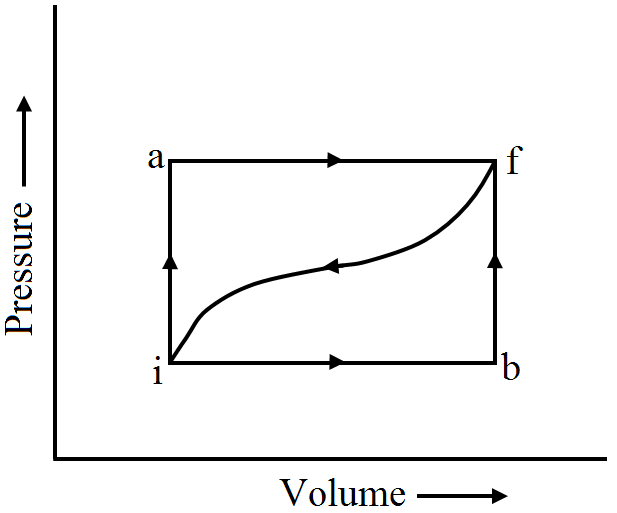
When a system is taken from state i to state f along the path iaf (see fig. below), it is found that the heat Q absorbed by the system is $50$ cal. and work done W by the system is equal to $20$ cal. along the path ibf; $Q = 36$ cal.
  1. What is W along the path ibf?
  2. If $W = -13$ cal. for the curved return path fi, what is for this path?
  3. Take $U_i= 10$ cal, what is $U_f$?
  4. If $U_b = 22$ cal. what are Q for the processes bf and ib?
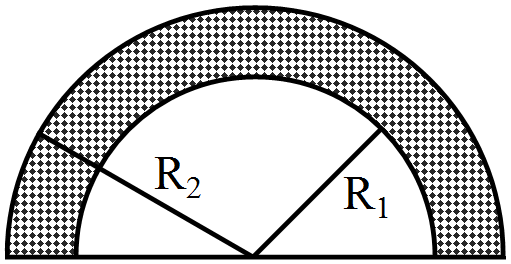
Find the centre of mass of a uniform plate having semicircular inner and outer boundaries of radii $R_1$ and $R_2$.
Find the magnetic field B at the centre of a rectangular loop of length l and width b, carrying a current i.
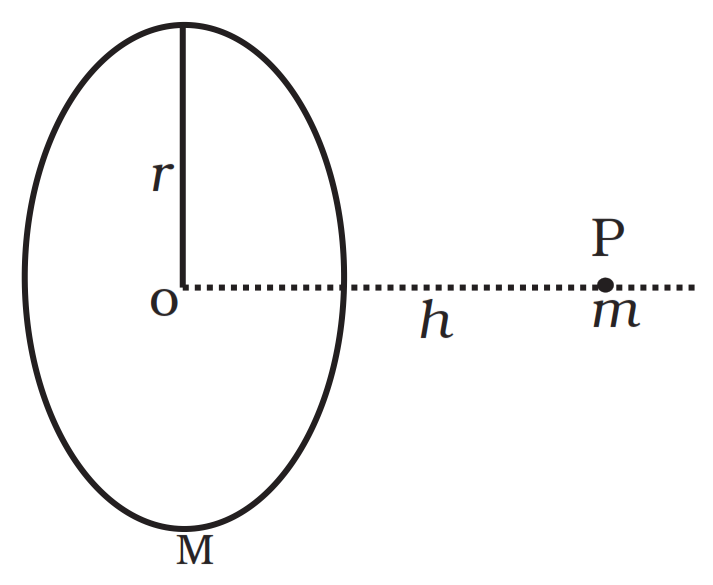
A mass m is placed at P a distance h along the normal through the centre O of a thin circular ring of mass M and radius r

If the mass is removed further away such that OP becomes 2h, by what factor the force of gravitation will decrease, if h = r?
A metal rod of cross sectional area $1.0 \mathrm{~cm}^2$ is being heated at one end. At one time, the temperature gradient is $5.0^{\circ} \mathrm{C} / \mathrm{cm}^{-1}$ at cross section A and is $2.5^{\circ} \mathrm{C} / \mathrm{cm}^{-1}$ at cross section B . Calculate the rate at which the temperature is increasing in the part $A B$ of the rod. The heat capacity of the part $A B=0.40 \rho^{\circ} \mathrm{C}^{-1}$, thermal conductivity of the material of the rod $=200 \mathrm{Wm}^{-1} \mathrm{C}^{-1}$. Neglect any loss of heat to the atmosphere.
What is a mess pendulum? Discuss its motion for small angular displacement. Deduce the formula for period. On which quantities does the periodic period depend?