Find the centre of mass of a uniform plate having semicircular inner and outer boundaries of radii $R_1$ and $R_2$. 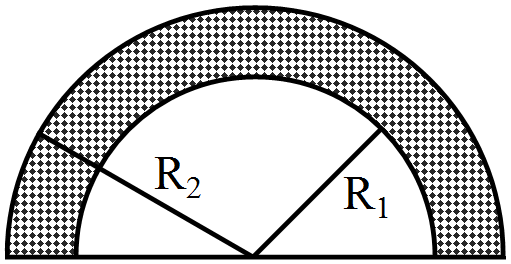
Download our app for free and get started
The centre of mass of the blate will be on the symmetrical axis.
$\Rightarrow\bar{\text{y}}_{\text{cm}}=\frac{\Big(\frac{\pi\text{R}_2^2}{2}\Big)\Big(\frac{\text{4R}_2}{3\pi}\Big)-\Big(\frac{\pi\text{R}_1^2}{2}\Big)\Big(\frac{4\text{R}_1}{3\pi}\Big)}{\frac{\pi\text{R}_2^2}{2}-\frac{\pi\text{R}_1^2}{2}}$
$=\frac{\Big(\frac{2}{3}\Big)\text{R}_2^3-\Big(\frac{2}{3}\Big)\text{R}_1^3}{\frac{\pi}{2}\big(\text{R}_2^2-\text{R}_1^2\big)}=\frac{4}{3\pi}\frac{(\text{R}_2-\text{R}_1)\big(\text{R}^2_2+\text{R}_1^2+\text{R}_1\text{R}_2\big)}{(\text{R}_2-\text{R}_1)(\text{R}_2+\text{R}_1)}$
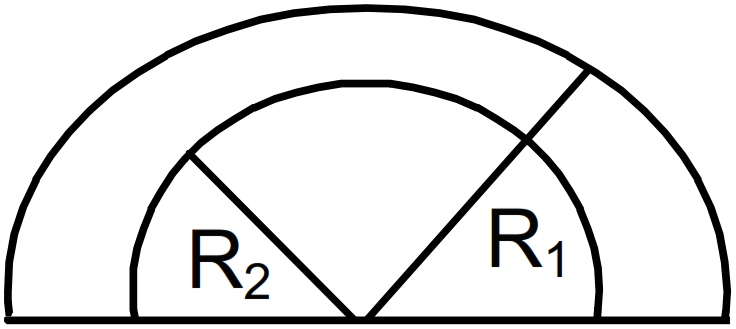
$=\frac{4}{3\pi}\frac{\big(\text{R}_2^2+\text{R}_1^2+\text{R}_1\text{R}_2\big)}{\text{R}_1+\text{R}_2}$ above the centre.
$\Rightarrow\bar{\text{y}}_{\text{cm}}=\frac{\Big(\frac{\pi\text{R}_2^2}{2}\Big)\Big(\frac{\text{4R}_2}{3\pi}\Big)-\Big(\frac{\pi\text{R}_1^2}{2}\Big)\Big(\frac{4\text{R}_1}{3\pi}\Big)}{\frac{\pi\text{R}_2^2}{2}-\frac{\pi\text{R}_1^2}{2}}$
$=\frac{\Big(\frac{2}{3}\Big)\text{R}_2^3-\Big(\frac{2}{3}\Big)\text{R}_1^3}{\frac{\pi}{2}\big(\text{R}_2^2-\text{R}_1^2\big)}=\frac{4}{3\pi}\frac{(\text{R}_2-\text{R}_1)\big(\text{R}^2_2+\text{R}_1^2+\text{R}_1\text{R}_2\big)}{(\text{R}_2-\text{R}_1)(\text{R}_2+\text{R}_1)}$
$=\frac{4}{3\pi}\frac{\big(\text{R}_2^2+\text{R}_1^2+\text{R}_1\text{R}_2\big)}{\text{R}_1+\text{R}_2}$ above the centre.

Download our appand get started for free
Experience the future of education. Simply download our apps or reach out to us for more information. Let's shape the future of learning together!No signup needed.*
Similar Questions
- 1The oxygen molecule has a mass of $5.30 \times 10^{-26}kg$ and a moment of inertia of $1.94 \times 10^{-46}kgm^2$ about an axis through its centre perpendicular to the lines joining the two atoms. Suppose the mean speed of such a molecule in a gas is $500m/s$ and that its kinetic energy of rotation is two thirds of its kinetic energy of translation. Find the average angular velocity of the molecule.View Solution
- 2In the HCl molecule, the separation between the nuclei of the two atoms is about $1.27\mathring{\text{A}}\big(1\mathring{\text{A}}= 10^{-10} \text{m}\big).$ Find the approximate location of the CM of the molecule, given that a chlorine atom is about 35.5 times as massive as a hydrogen atom and nearly all the mass of an atom is concentrated in its nucleus.View Solution
- 3$3$ A man stands on a rotating platform, with his arms stretched horizontally holding a $5kg$ weight in each hand. The angular speed of the platform is $30$ revolutions per minute. The man then brings his arms close to his body with the distance of each weight from the axis changing from $90cm$ to $20cm$. The moment of inertia of the man together with the platform may be taken to be constant and equal to $7.6kgm^2$.View Solution
- What is his new angular speed? (Neglect friction).
- Is kinetic energy conserved in the process? If not, from where does the change come about?
- 4Two blocks of masses $400g$ and $200g$ are connected through a light string going over a pulley which is free to rotate about its axis. The pulley has a moment of inertia $1.6 \times 10^{-4}kg-m^2$ and a radius 2.0cm. Find:View Solution
- The kinetic energy of the system as the $400g$ block falls through $50cm$.
- The speed of the blocks at this instant.
- 5The angular speed of a motor wheel is increased from $1200$ rpm to $3120$ rpm in $16$ seconds. $(i)$ What is its angular acceleration, assuming the acceleration to be uniform? $(ii)$ How many revolutions does the engine make during this time?View Solution
- 6Two masses $M_1$ and $M_2$ are separated by a distance r. Find the moment of inertia of this arrangement about an axis passing through the centre of mass and perpendicular to the line joining them.View Solution
- 7View SolutionShow that a(b × c) is equal in magnitude to the volume of the parallelepiped formed on the three vectors a, b and c.
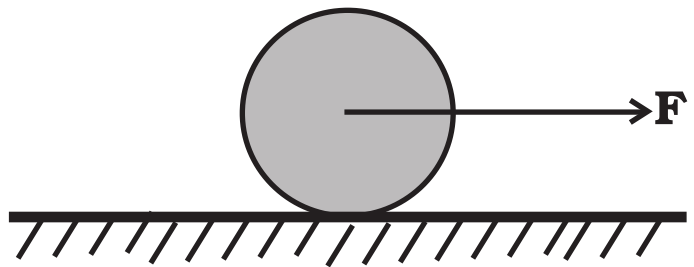
- 8A uniform disc of radius R, is resting on a table on its rim.The coefficient of friction between disc and table is $\mu.$Now the disc is pulled with a force F as shown in the figure. What is the maximum value of F for which the disc rolls without slipping?View Solution
- 9A disc of radius R is rotating with an angular speed $\omega_\text{o}$ about a horizontal axis. It is placed on a horizontal table. The coefficient of kinetic friction is $\mu_\text{k}{:}$View Solution
- What was the velocity of its centre of mass before being brought in contact with the table?
- What happens to the linear velocity of a point on its rim when placed in contact with the table?
- What happens to the linear speed of the centre of mass when disc is placed in contact with the table?
- Which force is responsible for the effects in (b) and (c).
- What condition should be satisfied for rolling to begin?
- Calculate the time taken for the rolling to begin.
- 10The pulley shown in figure has a radius $10cm$ and moment of inertia $0.5kg-m^2$ about its axis. Assuming the inclined planes to be frictionless, calculate the acceleration of the $4.0kg$ block.View Solution