MCQ
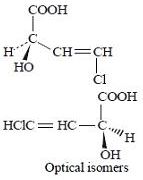
The compound $CHCl = CHCHOHCOOH$ with molecular formula $C_4H_5O_3Cl$ can exhibit
  • geometric, optical position and functional isomerism
  • B
    geometric, optical and functional isomerism only
  • C
    position and functional isomerism only
  • D
    geometric and optical isomerism only

Answer

Correct option: A.
geometric, optical position and functional isomerism
a
$\underset{Geometric\,isomers\,\,\,\,\,\,\,\,\,\,\,\,}{\mathop{\begin{align}
   \underset{\,\,\,cis\,\,\,\,\,\,\,\,\,\,\,\,\,\,\,\,\,\,\,\,\,\,\,\,\,\,\,\,\,\,\,\,\,\,}{\mathop{\begin{matrix}
   ^{H}  \\
   _{Cl}  \\
\end{matrix}\begin{matrix}
   \backslash   \\
   /  \\
\end{matrix}C=C\begin{matrix}
   /  \\
   \backslash   \\
\end{matrix}_{CHOHCOOH}^{H}}}\, \\ 
  \underset{trans\,\,\,\,\,\,\,\,\,\,\,\,\,\,\,\,\,\,\,\,\,\,\,\,\,\,\,}{\mathop{\begin{matrix}
   ^{H}  \\
   _{Cl}  \\
\end{matrix}\begin{matrix}
   \backslash   \\
   /  \\
\end{matrix}C=C\begin{matrix}
   /  \\
   \backslash   \\
\end{matrix}_{H}^{CHOHCOOH}}}\, \\ 
\end{align}}}\,$

$\begin{matrix}
   \,\,\,\,\,O  \\
   \,\,\,\,\,||  \\
   CH=C-C-OC{{H}_{3}}  \\
   \,\,|\,\,\,\,\,\,\,\,\,\,\,\,\,|\,\,\,\,\,\,\,\,\,\,\,\,\,\,\,\,\,\,\,\,\,\,\,\,\,\,\,\,\,\,\,\,\,\,\,  \\
   \,Cl\,\,\,\,\,\,\,\,\,OH\,\,\,\,\,\,\,\,\,\,\,\,\,\,\,\,\,\,\,\,\,\,\,\,\,\,\,\,\,\,\,\,\,  \\
\end{matrix}$ , $\begin{matrix}
   \,\,\,\,\,\,\,\,\,\,\,\,\,\,\,O  \\
   \,\,\,\,\,\,\,\,\,\,\,\,\,\,\,||  \\
   C{{H}_{3}}=C=C-OH  \\
   \,\,|\,\,\,\,\,\,\,\,\,\,\,\,\,|\,\,\,\,\,\,\,\,\,\,\,\,\,\,\,\,\,\,\,\,\,\,\,\,\,\,\,\,\,\,\,\,\,\,\,  \\
   \,Cl\,\,\,\,\,\,\,\,\,OH\,\,\,\,\,\,\,\,\,\,\,\,\,\,\,\,\,\,\,\,\,\,\,\,\,\,\,\,\,\,\,\,\,  \\
\end{matrix}$

           Functional isomers

$\begin{matrix}
   H\,\,\,\,\,\,\,\,\,\,\,\,\,\,\,\,  \\
   |\,\,\,\,\,\,\,\,\,\,\,\,\,\,\,\,\,  \\
   {{H}_{2}}C-C=C-COOH  \\
   |\,\,\,\,\,\,\,\,\,\,\,\,\,\,\,\,\,\,\,\,\,\,|\,\,\,\,\,\,\,\,\,\,\,\,\,\,\,\,\,\,\,\,  \\
   Cl\,\,\,\,\,\,\,\,\,\,\,\,\,\,\,\,\,\,OH\,\,\,\,\,\,\,\,\,\,\,\,\,\,\,\,\,  \\
\end{matrix}$ , $\begin{matrix}
   {{H}_{2}}C-C=CH-COOH  \\
   |\,\,\,\,\,\,\,\,\,\,\,\,|\,\,\,\,\,\,\,\,\,\,\,\,\,\,\,\,\,\,\,\,\,\,\,\,\,\,\,\,\,\,\,\,\,\,\,\,  \\
   Cl\,\,\,\,\,\,\,OH\,\,\,\,\,\,\,\,\,\,\,\,\,\,\,\,\,\,\,\,\,\,\,\,\,\,\,\,\,\,\,\,\,  \\
\end{matrix}$

            Position isomers
Need a full question paper?

Generate a complete, print-ready paper with questions like this in minutes — across 16+ boards, with answer keys.

Start Generating Free

Similar questions

$IUPAC$  name of $[Co(ONO){(N{H_3})_5}C{l_2}]$ is
The maximum wavelength of radiation that can ionise a sodium atom is $2414 \,\mathop A\limits^o .$ The ionisation energy of sodium per mole shall be
Which of the following represents the correct sets of the four quantum numbers of a $4d$ electron
If solubility of calcium hydroxide is $\sqrt 3 $, then its solubility product will be
Which of the following complex has highest $C-O$ bond length ?
Arrange decreasing order of reactivity of these compounds for nucleophilic substitution reaction

$(I)$ $\begin{array}{*{20}{c}}
  {\,\,\,\,\,\,\,\,\,\,\,\,\,\,\,\,\,\,\,\,\,\,\,\,O} \\ 
  {\,\,\,\,\,\,\,\,\,\,\,\,\,\,\,\,\,\,\,\,\,\,\,\,||} \\ 
  {C{H_3} - C{H_2} - O - S - C{F_3}} \\ 
  {\,\,\,\,\,\,\,\,\,\,\,\,\,\,\,\,\,\,\,\,\,\,\,||} \\ 
  {\,\,\,\,\,\,\,\,\,\,\,\,\,\,\,\,\,\,\,\,\,\,\,\,O} 
\end{array}$

$(II)$ $CH_3-CH_2-O-TsCl$

$(III)$ $\begin{array}{*{20}{c}}
  {C{H_3} - CH - C{H_3}} \\ 
  {|\,\,\,\,} \\ 
  {OH\,} 
\end{array}$

$(IV)$ $\begin{array}{*{20}{c}}
  {C{H_3} - CH - OH} \\ 
  | \\ 
  {{C_6}{H_5}} 
\end{array}$

Match List $I$ with List $II$

List $I$ (Spectral Series for Hyddrogen) List $II$ (Spectral Region/Higher Energy State)
$A$. Lyman $I$. Infrared region
$B$. Balmer $II$. $UV$ region
$C$. Paschen $III$. Infrared region
$D$. Pfund $IV$. Visible region

Choose the correct answer from the options given below :-

Predict the product when given compound ($A$, in the above question $4$) reacts  with $NaBH_4$ .
Incorrect statement regarding Friedel craft alkylation is
The correct order for the rate of decarboxylation of following compounds with sodalime will be