MCQ
The compound which does not show paramagnetism is :-
  • A
    $[Cu(NH_3)_4]Cl_2$
  • $[Ag(NH_3)_2]Cl$
  • C
    $NO$
  • D
    $NO_2$

Answer

Correct option: B.
$[Ag(NH_3)_2]Cl$
b

Need a full question paper?

Generate a complete, print-ready paper with questions like this in minutes — across 16+ boards, with answer keys.
Start Generating Free

Similar questions

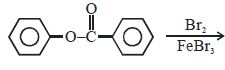
Product is
A transition metal ' $\mathrm{M}$ ' among $\mathrm{Sc}, \mathrm{Ti}, \mathrm{V}, \mathrm{Cr}, \mathrm{Mn}$ and $\mathrm{Fe}$ has the highest second ionisation enthalpy. The spin only magnetic moment value of $\mathrm{M}^{+}$ion is. . . . . . .$\mathrm{BM}$ (Near integer)

(Given atomic number $\mathrm{Sc}: 21, \mathrm{Ti}: 22, \mathrm{~V}: 23, \mathrm{Cr}$ : $24, \mathrm{Mn}: 25, \mathrm{Fe}: 26)$

Which of the following can react with alcohols to form esters :
Osmotic pressure of a urea solution at ${10\,^o}C$ is $500\,\,mm.$ Osmotic pressure of the solution become $105.3 \,mm$. When it is diluted and temperature raised to ${25\,^o}C.$ The extent of dilution is .......... times
The stabilisation of coordination compounds due to chelation is called the chelate effect. Which of the following is the most stable complex species?
Which of the following reagent reacts differently with $HCHO,\,C{H_3}CHO$ and $C{H_3}COC{H_3}$
Among $TiF_6^{2-} , CoF_6^{3-} , Cu_2Cl_2$ and $NiCl_4^{2-}$ the coloureless species are :
The standard reduction potentials at $298\,K$ for the following half reactions are given against each

$Z{n^{2 + }}\,(aq)\, + \,2e\, \rightleftharpoons \,Zn\,(s)\,;\, - \,0.762\,V$

$C{r^{3 + }}\,(aq)\, + \,3e\, \rightleftharpoons \,Cr(s)\,;\, - \,0.740\,\,V$

$2{H^ + }\,(aq)\, + \,2e\, \rightleftharpoons \,{H_2}(g)\,;\,\,\,0.00\,\,\,V$

$F{e^{3 + }}\,(aq)\, + \,e\, \rightleftharpoons \,F{e^{2 + }}(aq)\,;\,\,\,0.770\,\,\,V$

Which is the strongest reducing agent ?

Epoxides are
Which of the following has highest ionic radii