MCQ
The compound with the highest boiling point is
  • A
    $C{H_4}$
  • $C{H_3}OH$
  • C
    $C{H_3}Cl$
  • D
    $C{H_3}Br$

Answer

Correct option: B.
$C{H_3}OH$
b
(b)$C{H_3}OH$ has highest boiling point because of hydrogen bonding.

Need a full question paper?

Generate a complete, print-ready paper with questions like this in minutes — across 16+ boards, with answer keys.

Start Generating Free

Similar questions

For the reaction $PC{l_5}_{(g)}$ $\rightleftharpoons$ $PC{l_3}_{(g)} + C{l_2}_{(g)}$
$IUPAC$ name of the compound is $C{H_3} - CH = \mathop {\mathop {C - C{H_3}}\limits_{|\,\,\,\,\,\,\,\,\,\,\,\,\,\,} }\limits_{C{H_2} - C{H_2}} $
In which of the following reactions, there is no change in the valency
Which of the following organic chlorides will not give a Friedel-Craft alkylation  product when heated with benzene and $AlCl_3$ ?
For the reaction ${I_2} + 2{S_2}O_3^{2 - }\rightarrow  2{I^ - } + {S_4}O_6^{2 - }$,Correct option is
Following limiting molar conductivities are given as

$\lambda_{\mathrm{m}\left(\mathrm{H}_{2} \mathrm{SO}_{4}\right)}^{0}=\mathrm{x} \;\mathrm{S}\; \mathrm{cm}^{2} \mathrm{mol}^{-1}$

$\lambda_{\mathrm{m}\left(\mathrm{K}_{2} \mathrm{SO}_{4}\right)}^{0}=\mathrm{y} \;\mathrm{S\;cm}^{2} \mathrm{mol}^{-1}$

$\lambda_{\mathrm{m}(\mathrm{CH_3} \mathrm{COOK})}^{0}=\mathrm{z}\; \mathrm{S\;cm}^{2} \mathrm{mol}^{-1}$

$\lambda_{\mathrm{m}}^{0}\left(\mathrm{in}\; \mathrm{S} \;\mathrm{cm}^{2} \mathrm{mol}^{-1}\right)$ for $\mathrm{CH}_{3} \mathrm{COOH}$ will be
An electron in a hydrogen atom in its ground state absorbs $2$ times as much energy as the minimum required for it to escape from the atom. The kinetic energy of the emitted electron is ............ $\mathrm{eV}$
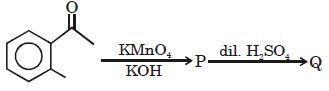
Major product $(Q)$ of following reaction is used to form :
Assertion : Iodide ion combines with smaller group to avoid steric hindrance.
Reason : With $HI$, anisole gives iodobenzene and methyl alcohol.
Aniline with solid $KOH$ and $CS_2$ gives :