MCQ
The compressibility of a material is
  • A
    Product of volume and its pressure
  • B
    The change in pressure per unit change in volume strain
  • The fractional change in volume per unit change in pressure
  • D
    None of the above

Answer

Correct option: C.
The fractional change in volume per unit change in pressure
c
(c)$\frac{1}{K} = $compressibility $ = \left( {\frac{{ - \Delta V/V}}{{\Delta P}}} \right)$

Need a full question paper?

Generate a complete, print-ready paper with questions like this in minutes — across 16+ boards, with answer keys.
Start Generating Free

Similar questions

At what temperature $r.m.s.$ speed of air molecules doubles of that at $N.T.P.$ is ...... $^oC$
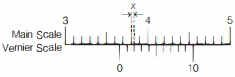
The figure of a centimetre scale below shows a particular position of the Vernier calipers. In this position, the value of $x$ shown in the figure is .......... $cm$ (figure is not to scale)
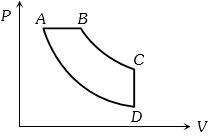
In pressure-volume diagram given below, the isochoric, isothermal, and isobaric parts respectively, are
Let us consider a system of units in which mass and angular momentum are dimensionless. If length has dimension of $L$, which of the following statement ($s$) is/are correct ?

$(1)$ The dimension of force is $L ^{-3}$

$(2)$ The dimension of energy is $L ^{-2}$

$(3)$ The dimension of power is $L ^{-5}$

$(4)$ The dimension of linear momentum is $L ^{-1}$
A bullet of mass $A$ and velocity $B$ is fired into a block of wood of mass $C$. If loss of any mass and friction be neglected, the velocity of the system must be:
$1\, mole$ of an ideal monoatomic gas at temperature $'T_0'$ expands slowly according to the law $P = KV$, where $K$ is a constant. If the final temperature of the gas is $2T_0$. Find the heat supplied to the gas
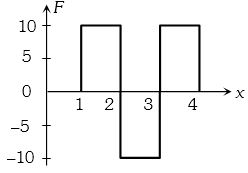
Figure shows the $F-x$ graph. Where $F$ is the force applied and $x$ is the distance coveredby the body along a straight line path. Given that $F$ is in newton and $x$ in metre, ........ $J$ is the work done.
Four modifications are suggested in the lens formula to include the effect of the thickness t of the lens. Which one is likely to be correct?
Two boys are standing at the ends $A$ and $B$ of a ground where $AB = a$. The boy at $B$ starts running in a direction perpendicular to $AB$ with velocity ${v_1}.$ The boy at $A$ starts running simultaneously with velocity $v$ and catches the other boy in a time $t$, where $t$ is
A particle of mass $\mathrm{m}$ is fixed to one end of a light spring having force constant $\mathrm{k}$ and unstretched length $\ell .$ The other end is fixed. The system is given an angular speed $\omega$ about the fixed end of the spring such that it rotates in a circle in gravity free space. Then the stretch in the spring is