Question
The compression factor (compressibility factor) for one mole of a van der Waals gas at 0°C and 100 atm pressure is found to be 0.5. Assuming that the volume of a gas molecule is negligible, calculate the van der Waals' constant a.

Answer

$\text{Z}=\frac{\text{pV}}{\text{nRT}},$ i.e.
$0.5=\frac{100\times\text{V}}{1\times0.082\times273}$
$\text{V}=0.1119\text{L}$
$\Big(\text{p}+\frac{\text{a}}{\text{V}^2}\Big)(\text{V}-\text{b})=\text{RT for }1\text{mol}$
Neglecting b, $\Big(\text{p}+\frac{\text{a}}{\text{V}^2}\Big)\text{V}=\text{RT}$
$\text{pV}+\frac{\text{a}}{\text{V}}=\text{RT}$
$\frac{\text{pV}}{\text{RT}}+\frac{\text{a}}{\text{VRT}}=1$
$\text{a}=\Big(1-\frac{\text{pV}}{\text{RT}}\Big)\text{VRT}$
$=(1-0.5)0.1119\times0.082\times273$
$=1.252\text{atm L}^2\text{mol}^{-2}$

Need a full question paper?

Generate a complete, print-ready paper with questions like this in minutes — across 16+ boards, with answer keys.
Start Generating Free

Similar questions

A 25watt bulb emits monochromatic yellow light of wavelength of 0.57µm. Calculate the rate of emission of quanta per second.
The magnitude of surface tension of liquid depends on the attractive forces between the molecules. Arrange the following in increasing order of surface tension:
water, alcohol $\left(\mathrm{C}_2 \mathrm{H}_5 \mathrm{OH}\right)$ and hexane $\left.\left[\mathrm{CH}_3\left(\mathrm{CH}_2\right)_4 \mathrm{CH}_3\right)\right]$.
100 mL of a liquid is contained in an insulated container at a pressure of 1 bar. The pressure is steeply increased to 100 bar. The volume of the liquid is decreased by 1 mL at this constant pressure. Find $\Delta H$ and $\Delta U$.
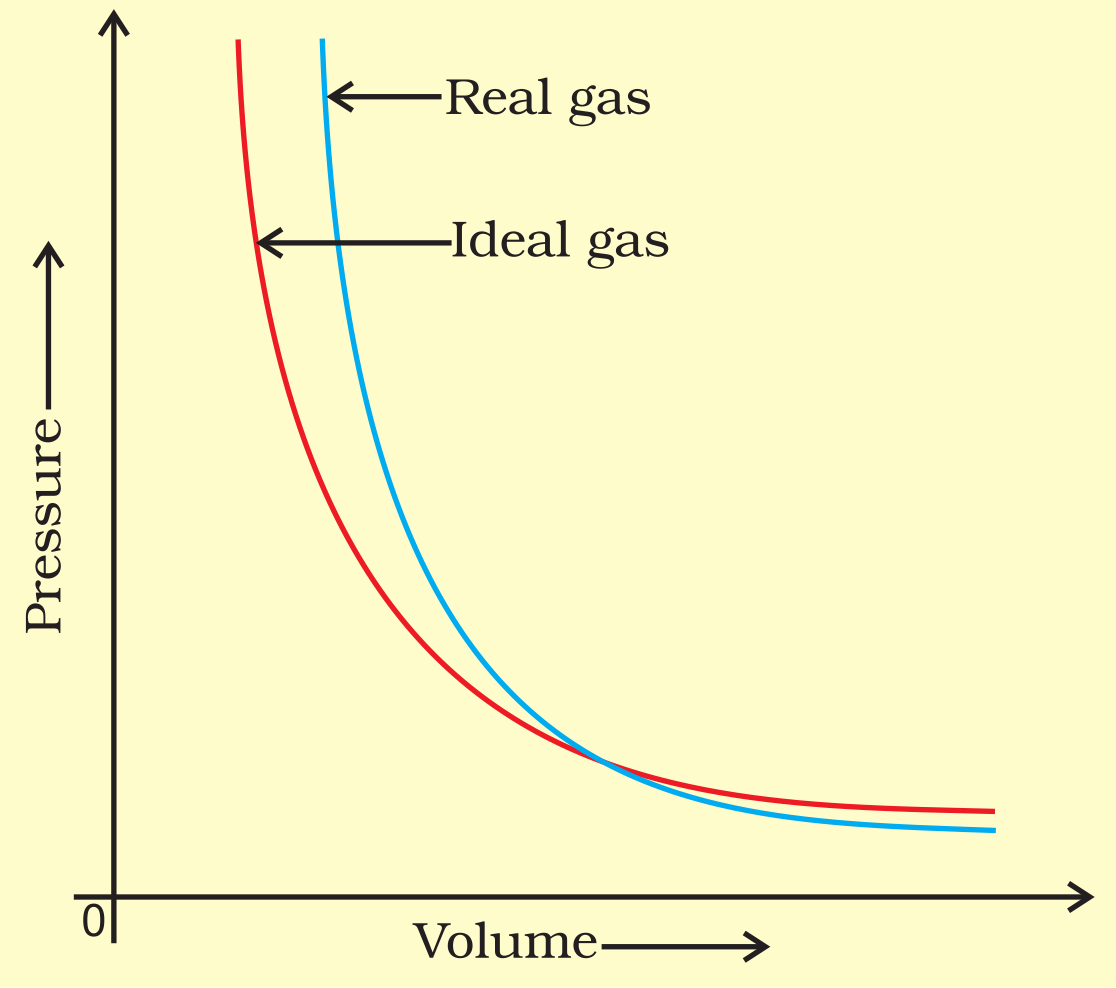
Pressure versus volume graph for a real gas and an ideal gas are shown in Fig. Answer the following questions on the basis of this graph.
  1. Interpret the behaviour of real gas with respect to ideal gas at low pressure.
  2. Interpret the behaviour of real gas with respect to ideal gas at high pressure.
  3. Mark the pressure and volume by drawing a line at the point where real gas behaves as an ideal gas.
Which of the following has higher dipole moment:
1-butene or 1-butyne, why?
Write the important conditions required for the linear combination of atomic orbitals to form molecular orbitals.
Find the temperature at which liquid water and water vapour will be in equilibrium.
$
\left(\Delta H_{\text {vap }}=40.73 kJ mol^{-1}=40.73 \times 1000 J mol^{-1}\right)
$
How many litres of oxygen are required for complete combustion of 6.0 gram of ethane at standard temperature and pressure.
Justify the following statements.
  1. Reactions with $\Delta\text{G}<0$ always have an equilibrium constant greater than 1.
  2. Many thermodynamically feasible reactions do not occur under ordinary conditions.
  3. At low temperatures, enthalpy change dominates the $\Delta\text{G}$ expression and at high temperatures, it is the entropy which dominates the value of $\Delta\text{G}.$
A sample of pure $PCl _5$ was introduced into an evacuated vessel at 473 K . After equilibrium was attained, concentration of $PCl _5$ was found to be $0.5 \times 10^{-1} mol L ^{-1}$. If value of $K _{ c }$ is $8.3 \times 10^{-3}$, what are the concentrations of $PCl _3$ and $Cl _2$ at equilibrium?
$PCl_5(g) \rightleftharpoons PCl_3(g)+Cl_2(g)$