Question
Justify the following statements.
  1. Reactions with $\Delta\text{G}<0$ always have an equilibrium constant greater than 1.
  2. Many thermodynamically feasible reactions do not occur under ordinary conditions.
  3. At low temperatures, enthalpy change dominates the $\Delta\text{G}$ expression and at high temperatures, it is the entropy which dominates the value of $\Delta\text{G}.$
Answer

  1. $\Delta\text{G}=-2.303\text{RT}\log\text{K}.$ Thus, when $\Delta\text{G}^\circ<0,$ K > 1).
  2. Under ordinary conditions, the average energy of the reactants may be less than threshold energy. They require some activation energy to initiate the reaction.
  3. $\Delta\text{G}=​​\Delta\text{H}-\text{T}\Delta\text{S}.$ At low temperature, $\text{T}\Delta\text{S}$ is small. Hence, $\Delta\text{H}$ dominates. At high temperature, $\text{T}\Delta\text{S}$ is large, i.e. $\Delta\text{S}$ dominates the value of $\Delta\text{G}.$
Need a full question paper?

Generate a complete, print-ready paper with questions like this in minutes — across 16+ boards, with answer keys.

Start Generating Free

Similar questions

Why do beryllium and magnesium not impart colour to the flame in the flame test?
a. Consider the isoelectronic species, $\mathrm{Na}^{+}, \mathrm{Mg}^{2+}, \mathrm{F}^{-}$and $\mathrm{O}^{2-}$. What is the correct order of increasing length of their radii and why?
b. Si is semiconductor whereas ' C ' is non-metal, why?

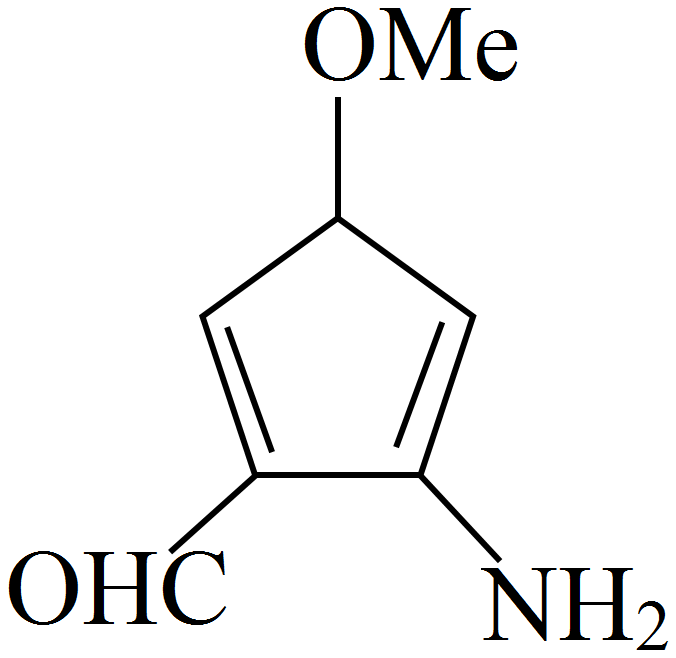
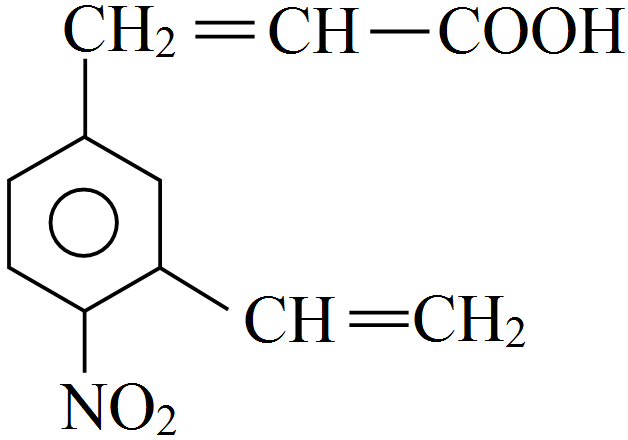
Identify the functional groups present in the following compounds.
  1.  
  1.  
  1. $\text{CH}_3-\text{CH}_2-\text{CO}-\text{CH}_2\\ \ \ \ \ \ \ \ \ \ \ \ \ \ \ \ \ \ \ \ \ \ \ \ \ \ \ \ \ \ \ \ \ \ \ \ \ \ |\\ \ \ \ \ \ \ \ \ \ \ \ \ \ \ \ \ \ \ \ \ \ \ \ \ \text{CH}_2-\text{COCl}$
  2. $\ \ \ \ \ \ \ \ \ \ \ \ \ \ \ \ \ \ \ \ \ \ \ \ \ \ \ \ \ \ \ \ \ \ \ \ \ \text{O}\\ \ \ \ \ \ \ \ \ \ \ \ \ \ \ \ \ \ \ \ \ \ \ \ \ \ \ \ \ \ \ \ \ \ \ \ \ \ \|\\\text{CH}_2=\text{CH}-\text{CH}_2-\text{C}-\text{NH}_2$
How many moles of $CO _2$ are obtained from complete combustion of 21 gm propene?
Give the relationship between $\Delta U$ and $\Delta H$ for gases.
How many $\sigma$ and $\sigma-$bonds are present in $\text{CH}_2=\text{C}-\text{CH}=\text{CH}_2?$
Balance the following equations by the oxidation number method.
$\text{MnO}_2+\text{C}_2\text{O}^{2-}_4\xrightarrow{ \ \ \ \ \ \ \ }\text{Mn}^{2+}+\text{CO}_2$
Calculate the wavelength of the spectral line obtained in the spectrum of $Li^{2+}$ ion when the transition takes place between two levels whose sum is 4 and the difference is 2.
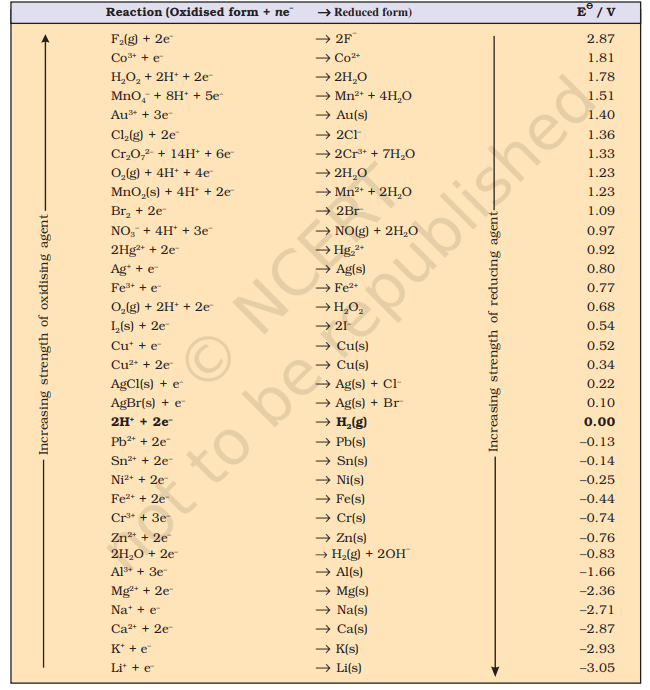
Using the standard electrode potentials given in the Table, predict if the reaction between the following is feasible:
$\mathrm{Ag}^{+}(\mathrm{aq})$ and $\mathrm{Cu}(\mathrm{s})$.
From where does ozone come in the photochemical smog?