MCQ
The condition for a uniform spherical mass $m$ of radius $r$ to be a black hole is [$G=$ gravitational constant and $g=$ acceleration due to gravity]
  • A
    ${(2Gm/r)^{1/2}} \le c$
  • B
    ${(2Gm/r)^{1/2}} = c$
  • ${(2Gm/r)^{1/2}} \ge c$
  • D
    ${(gm/r)^{1/2}} \ge c$

Answer

Correct option: C.
${(2Gm/r)^{1/2}} \ge c$
c
(c)Escape velocity for that body ${v_e} = \sqrt {\frac{{2Gm}}{r}} $
${v_e}$ should be more than or equal to speed of light
i.e.$\sqrt {\frac{{2Gm}}{r}} \ge c$

Need a full question paper?

Generate a complete, print-ready paper with questions like this in minutes — across 16+ boards, with answer keys.

Start Generating Free

Similar questions

A body is projected from ground at an angle ${\theta _1}$ with the horizontal with kinetic energy $K$. What is the potential energy of the body, when the velocity makes an angle ${\theta _2}$ with the horizontal?
The two thigh bones (femurs), each of cross-sectional area $10\; cm ^{2}$ support the upper part of a human body of mass $40\; kg$. Estimate the average pressure sustained by the femurs.
Two spherical stars $A$ and $B$ have densities $\rho_A$ and $\rho_B$, respectively. $A$ and $B$ have the same radius, and their masses $M_A$ and $M_B$ are related by $M_B=2 M_A$. Due to an interaction process, star $A$ loses some of its mass, so that its radius is halved, while its spherical shape is retained, and its density remains $\rho_A$. The entire mass lost by $A$ is deposited as a thick spherical shell on $B$ with the density of the shell being $\rho_4$. If $v_A$ and $v_B$ are the escape velocities from $A$ and $B$ after the interaction process, the ratio $\frac{v_B}{v_A}=\sqrt{\frac{10 n}{15^{1 / 3}}}$. The value of $n$ is. . . . .
The ratio of the accelerations for a solid sphere (mass $m$ and radius $R$) rolling down an incline of angle $\theta$ without slipping and slipping down the incline without rolling is
An expression for a dimensionless quantity $P$ is given by $P=\frac{\alpha}{\beta} \log _{e}\left(\frac{ kt }{\beta x }\right)$; where $\alpha$ and $\beta$ are constants, $x$ is distance ; $k$ is Boltzmann constant and $t$ is the temperature. Then the dimensions of $\alpha$ will be
A capillary tube is immersed vertically in water and the height of the water column is $x$. When this arrangement is taken into a mine of depth $d$, the height of the water column is $y$. If $R$ is the radius of earth, the ratio $\frac{x}{y}$ is
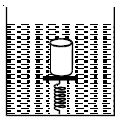
A cylindrical block of area of cross-section $A$ and of material of density $\rho$ is placed in a liquid of density one-third of density of block. The block compresses a spring and compression in the spring is one-third of the length of the block. If acceleration due to gravity is $g$, the spring constant of the spring is:
The value of the sum of two vectors $\overrightarrow A $ and $\overrightarrow B $ with $\theta $ as the angle between them is
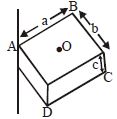
Figure shows a uniform solid block of mass $M$ and edge lengths $a, b$ and $c$. Its $M.I.$ about an axis through one edge and perpendicular (as shown) to the large face of the block is
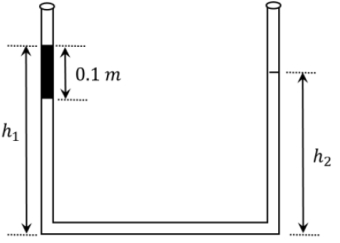
An open-ended U-tube of uniform cross-sectional area contains water (density $10^3 kg m ^{-3}$ ). Initially the water level stands at $0.29 m$ from the bottom in each arm. Kerosene oil (a water-immiscible liquid) of density $800 kg m ^{-3}$ is added to the left arm until its length is $0.1 m$, as shown in the schematic figure below. The ratio $\left(\frac{h_1}{h_2}\right)$ of the heights of the liquid in the two arms is-