MCQ
Two spherical stars $A$ and $B$ have densities $\rho_A$ and $\rho_B$, respectively. $A$ and $B$ have the same radius, and their masses $M_A$ and $M_B$ are related by $M_B=2 M_A$. Due to an interaction process, star $A$ loses some of its mass, so that its radius is halved, while its spherical shape is retained, and its density remains $\rho_A$. The entire mass lost by $A$ is deposited as a thick spherical shell on $B$ with the density of the shell being $\rho_4$. If $v_A$ and $v_B$ are the escape velocities from $A$ and $B$ after the interaction process, the ratio $\frac{v_B}{v_A}=\sqrt{\frac{10 n}{15^{1 / 3}}}$. The value of $n$ is. . . . .
  • $2.30$
  • B
    $2.35$
  • C
    $2.40$
  • D
    $2.45$

Answer

Correct option: A.
$2.30$
a
Given $R_A=R_B=R$

$M _{ B }=2 M _{ A }$

Calculation of escape velocity for $A$ :

Radius of remaining star $=\frac{R_A}{2}$.

Mass of remaining star $=\rho_A \frac{4}{3} \pi \frac{R_A^3}{8}=\frac{M_A}{8}$

$\frac{- GM _{ A / B }}{ R _{ A / 2}}+\frac{1}{2} mv _{ A }^2=0 \Rightarrow v _{ A }=\sqrt{\frac{2 GM _{A / B}}{ R _{A / 2}}}=\sqrt{\frac{ GM _A}{2 R }}$

Calculation of escape velocity for $B$

Mass collected over $B =\frac{7}{8} M _{\text {A }}$

Let the radius of $B$ becomes $r$.

$\therefore \frac{4}{3} \pi\left( r ^3- R _B^3\right) \rho_A=\frac{7}{8} \rho_A \frac{4}{3} \pi R _A^3 \Rightarrow \pi^3=\frac{7}{8} R _A^3+ R _{ B }^3=\frac{(15)^{1 / 3} R }{2}$

$\therefore \frac{ V _{ B }^2}{2}=\frac{23 GM _A}{8 \times 15^{1 / 3} \frac{ R }{2}}=\frac{23 GM _A}{4 \times 15^{1 / 3} R }$

$\therefore V _{ B }=\sqrt{\frac{23 GM _A}{2 \times 15^{1 / 3} R }}$

$\therefore \frac{ V _{ B }}{ V _A}=\sqrt{\frac{23}{15^{1 / 3}}}=\sqrt{\frac{10 \times 2.30}{15^{1 / 3}}}$

$n =2.30$

Need a full question paper?

Generate a complete, print-ready paper with questions like this in minutes — across 16+ boards, with answer keys.

Start Generating Free

Similar questions

A very broad elevator is going up vertically with a constant acceleration of $2\,m / s ^2$. At the instant when its velocity is $4\,m / s$ a ball is projected from the floor of the lift with a speed of $4\,m / s$ relative to the floor at an elevation of $30^{\circ}$. The time taken by the ball to return the floor is $..............\,s$ $\left(g=10\,m / s ^2\right)$
The limiting friction between two bodies in contact is independent of
A circular disc has a mass of $1\ kg$ and radius $40\ cm$. It is rotating about an axis passing through its centre and perpendicular to its plane with a speed of $10\ rev/s$. The work done in joules in stopping it would be ...... $J$
The maximum and minimum distances of a comet from the sun are $8 \times {10^{12}}\,m$ and $1.6 \times {10^{12}}\,m$. If its velocity when nearest to the sun is $60\, m/s$, what will be its velocity in $m/s$ when it is farthest 
A particle is moving along a straight line with constant acceleration. At the end of tenth  second its velocity becomes $20\, m/s$ and in tenth second it travels a distance of $10\, m$.  Then the acceleration of the particle will be........$m/s^2$
Two men with weights in the ratio $4:3$ run up a staircase in time in the ratio $12:11$. The ratio of power of the first to that of second is
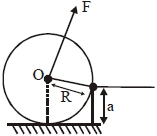
A uniform cylinder of mass $M$ and radius $R$ is to be pulled over a step of height $a (a < R$) by applying a force $F$ at its centre $'O'$ perpendicular to the plane through the axes of the cylinder on the edge of the step ( see figure). The minimum value of $F$ required is 
If the length of the pendulum in pendulum clock increases by $0.1\, \%$, then the error in time per day is: (in $s$)
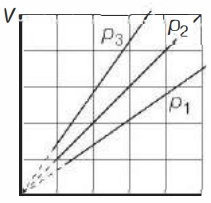
The state of an ideal gas was changed isobarically. The graph depicts three such isobaric lines. Which of the following is true about the pressures of the gas?
A body starting from rest moves with constant acceleration. The ratio of distance covered by the body during the $5^{th}$ sec to that covered in $5\, sec$ is