MCQ
The conjugate acid of $NH _2{ }^{-}$is :
- A$NH _4^{+}$
- B$N _2 H _4$
- ✓$NH _3$
- DNone of these
Generate a complete, print-ready paper with questions like this in minutes — across 16+ boards, with answer keys.
(image)
$A \rightarrow B$ is an adiabatic process. If the total heat absorbed in the entire process ( $A \rightarrow B$ and $B \rightarrow C$ ) is $R T_2 \ln 10$, the value of $2 \log V_3$ is . . . . . [Use, molar heat capacity of the gas at constant pressure, $\mathrm{C}_{\mathrm{p}, \mathrm{m}}=\frac{5}{2} \mathrm{R}$ ]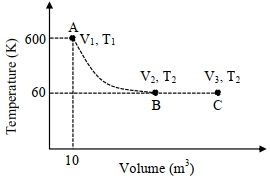
$R - X \rightarrow R ^{\oplus} X ^{\ominus} \rightarrow R ^{\oplus} \| X ^{\ominus} \stackrel{ Y^\ominus }{\rightarrow} R - Y + X ^{\ominus}$
Ion pair Solvent separated ion pair
A student writes general characteristics based on the given mechanism as:
$(a)$ The reaction is favoured by weak nucleophiles
$(b)$ $R^ \oplus$ would be easily formed if the substituents are bulky
$(c)$ The reaction is accompained by recemization
$(d)$ The reaction is favoured by non-polar solvents.
Which observations are correct $?$