MCQ
The continuous $X-$ rays spectrum produced by an $X-$ ray machine at constant voltage has
  • A
    A maximum wavelength
  • A minimum wavelength
  • C
    A single wavelength
  • D
    A minimum frequency

Answer

Correct option: B.
A minimum wavelength
b
(b)Continuous spectrum of $X-$ rays consists of radiations of all possible wavelength range having a definite short wavelength limit.

Need a full question paper?

Generate a complete, print-ready paper with questions like this in minutes — across 16+ boards, with answer keys.
Start Generating Free

Similar questions

The electron in hydrogen atom in a sample is in $n^{th}$ excited state, then the number of different spectrum lines obtained in its emission spectrum will be :
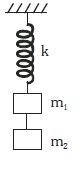
Two masses $m_1$ and $m_2$ are supended together by a massless spring of constant $k$. When the masses are in equilibrium, $m_1$ is removed without disturbing the system; the amplitude of vibration is
A sphere is suspended by a thread of length $l$. What minimum horizontal velocity has to be imparted the ball for it to reach the height of the suspension
Assertion : Newton’s rings are formed in the reflected system when the space between the lens and the glass plate is filled with a liquid of refracitve index greater than that of glass, the central spot of the pattern is bright.

Reason : This is because the reflection in these cases will be from a denser to rarer medium and the two interfering rays are reflected under similar conditions.
For continuous $X-$ rays produced wavelength is
A polyatomic gas with six degrees of freedom does $25\,\,J$ of work when it is expanded at constant pressure. The heat given to the gas is ..... $J$
In damped oscillations, damping force is directly proportional to speed of oscillator. If amplitude becomes half of its maximum value in $1 \,s$, then after $2 \,s$ amplitude will be $\left(A_0-\right.$ initial amplitude)
Which of the following expressions represent simple harmonic motion
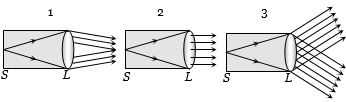
The slit of a collimator is illuminated by a source as shown in the adjoining figures. The distance between the slit $S$ and the collimating lens $L$ is equal to the focal length of the lens. The correct direction of the emergent beam will be as shown in figure
A body of mass $2\,kg$ is moving with velocity $10 \,m/s$ towards east. Another body of same mass and same velocity moving towards north collides with former and coalsces and moves towards north-east. Its velocity is