MCQ
The control rod in a nuclear reactor is made of
  • A
    Uranium
  • Cadmium
  • C
    Graphite
  • D
    Plutonium

Answer

Correct option: B.
Cadmium
b
(b) Control rods are used in nuclear reactors to control the fision rate of uranium and plutonium. They are composed of chemical elements such as boron, silver, indium and cadmium that are capable of absorbing many neutrons without themselves fissioning

Need a full question paper?

Generate a complete, print-ready paper with questions like this in minutes — across 16+ boards, with answer keys.
Start Generating Free

Similar questions

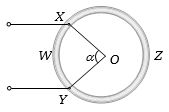
A wire of resistor $R$ is bent into a circular ring of radius $r$. Equivalent resistance between two points $X$ and $Y$ on its circumference, when angle $XOY$ is $\alpha$, can be given by
The power of a lens (biconvex) is $1.25\,m ^{-1}$ in particular medium. Refractive index of the lens is $1.5$ and radii of curvature are $20\,cm$ and $40\,cm$ respectively. The refractive index of surrounding medium.
The velocity of a particle depends upon the time $t$ according to the equation $v = \sqrt {ab}  + bt + \frac{c}{{d + t}}$ The physical quantities which are represented by $a, b, c$ and $d$, are in the following order
A thin plano convex lens made of glass of refractive index 1.5 is immersed in a liquid of refractive index 1.2 . When the plane side of the lens is silver coated for complete reflection, the lens immersed in the liquid behaves like a concave mirror of focal length 0.2 m . The radius of curvature of the curved surface of the lens is :-
A charge of $5\,C$ is given a displacement of $0.5\,m$. The work done in the process is $10\,J$. The potential difference between the two points will be.......$V$
Speed of sound in a gas is $v$ and $r.m.s.$ velocity of the gas molecules is $c.$ The ratio of $v$ to $c$ is
A set of defective observation of weights is used by a student to find the mass of an object using a physical balance. A large number of readings will reduce
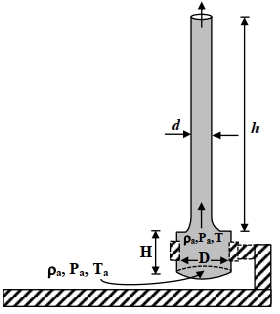
A cylindrical furnace has height $(H)$ and diameter $(D)$ both $1 \mathrm{~m}$. It is maintained at temperature $360 \mathrm{~K}$. The air gets heated inside the furnace at constant pressure $P_a$ and its temperature becomes $T=360 \mathrm{~K}$. The hot air with density $\rho$ rises up a vertical chimney of diameter $d=0.1 \mathrm{~m}$ and height $h=9 \mathrm{~m}$ above the furnace and exits the chimney (see the figure). As a result, atmospheric air of density $\rho_a=1.2 \mathrm{~kg} \mathrm{~m}^{-3}$, pressure $P_a$ and temperature $T_a=300 \mathrm{~K}$ enters the furnace. Assume air as an ideal gas, neglect the variations in $\rho$ and $T$ inside the chimney and the furnace. Also ignore the viscous effects.

[Given: The acceleration due to gravity $g=10 \mathrm{~ms}^{-2}$ and $\pi=3.14$ ]

(image)

($1$) Considering the air flow to be streamline, the steady mass flow rate of air exiting the chimney is

. . . . .$\mathrm{gm} \mathrm{s}^{-1}$.

($2$) When the chimney is closed using a cap at the top, a pressure difference $\Delta P$ develops between the top and the bottom surfaces of the cap. If the changes in the temperature and density of the hot air, due to the stoppage of air flow, are negligible then the value of $\Delta P$ is. . . . .$\mathrm{Nm}^{-2}$.
The curve drawn between velocity and frequency of photon in vacuum will be a
Red light is generally used to observe diffraction pattern from single slit. If blue light is used instead of red light, then diffraction pattern