MCQ
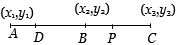
The coordinates of the points $A, B, C$ are $({x_1},{y_1})$, $({x_2},{y_2})$, $({x_3},\,{y_3})$ and $D$ divides the line $AB$ in the ratio $l : k$. If $P$ divides the line $DC$ in the ratio $m : k + l$, then the coordinates of $P$ are
  • $\left( {\frac{{k{x_1} + l{x_2} + m{x_3}}}{{k + l + m}},\,\frac{{k{y_1} + l{y_2} + m{y_3}}}{{k + l + m}}} \right)$
  • B
    $\left( {\frac{{l{x_1} + m{x_2} + k{x_3}}}{{l + m + k}},\,\frac{{l{y_1} + m{y_2} + k{y_3}}}{{l + m + k}}} \right)$
  • C
    $\left( {\frac{{m{x_1} + k{x_2} + l{x_3}}}{{m + k + l}},\,\frac{{m{y_1} + k{y_2} + l{y_3}}}{{m + k + l}}} \right)$
  • D
    None of these

Answer

Correct option: A.
$\left( {\frac{{k{x_1} + l{x_2} + m{x_3}}}{{k + l + m}},\,\frac{{k{y_1} + l{y_2} + m{y_3}}}{{k + l + m}}} \right)$
a
(a) Coordinates of $D$ will be $\left( {\frac{{l{x_2} + k{x_1}}}{{l + k}},\,\,\frac{{l{y_2} + k{y_1}}}{{l + k}}} \right)$

Now again, $DC$ is divided by $P$  in $m:k + l.$

Then the coordinates of $P$ will be given by

$\left( {\frac{{m{x_3} + l{x_2} + k{x_1}}}{{k + l + m}},\,\frac{{m{y_3} + l{y_2} + k{y_1}}}{{k + l + m}}} \right)$.

Need a full question paper?

Generate a complete, print-ready paper with questions like this in minutes — across 16+ boards, with answer keys.

Start Generating Free

Similar questions

Let $P$ and $Q$ be two distinct points on a circle which has center at $C(2,3)$ and which passes through origin $O$ , If $O C$ is perpendicular to both the line segments $C P$ and $C Q$, then the set $\{\mathrm{P}, \mathrm{Q}\}$ is equal to:
Consider an arithmetic series and a geometric series having four initial terms from the set $\{11,8,21,16,26,32,4\}$ If the last terms of these series are the maximum possible four digit numbers, then the number of common terms in these two series is equal to .......
The graph of the equation $y^2+z^2=0$ in three dimensional space is:
The total number of 9 digit numbers of different digits is:
Let,$S=\left\{\theta \in[0,2 \pi]: 8^{2 \sin ^{2} \theta}+8^{2 \cos ^{2} \theta}=16\right\}$. Then $n ( S )+\sum_{\theta \in S}\left(\sec \left(\frac{\pi}{4}+2 \theta\right) \operatorname{cosec}\left(\frac{\pi}{4}+2 \theta\right)\right)$ is equal to.
$(13)^{507}$ when divided by $9$ leaves the remainder :-
The centre of $14{x^2} - 4xy + 11{y^2} - 44x - 58y + 71 = 0$
The sum of squares of deviations for $10$ observations taken from mean $50$ is $250$. The co-efficient of variation is.....$\%$
If $A = \{ 2,\,4,\,5\} ,\,\,B = \{ 7,\,\,8,\,9\} ,$ then $n(A \times B)$ is equal to
Let $A $ and $B$ donate the statements.

$A:$$\cos \alpha + \cos \beta + \cos \gamma = 0$

$B$:$\sin \alpha + \sin \beta + \sin \gamma = 0$

If $\cos \left( {\alpha - \beta } \right) + \cos \left( {\beta - \gamma } \right) + \cos \left( {\gamma - \alpha } \right) = - \frac{3}{2}$ then