MCQ
The coordination number of a central metal atom in a complex is determined by
  • A
    the number of only anionic ligands bonded to the metal ion
  • B
    the number of monodentate ligands around a metal ion bonded by $\pi-$ bonds
  • C
    the number of monodentate ligands around a metal ion bonded by a and $\pi-$ bonds both
  • the number of monodentate ligands around a metal ion bonded by $\sigma-$ bonds
Answer

Correct option: D.
the number of monodentate ligands around a metal ion bonded by $\sigma-$ bonds
d

Need a full question paper?

Generate a complete, print-ready paper with questions like this in minutes — across 16+ boards, with answer keys.

Start Generating Free

Similar questions

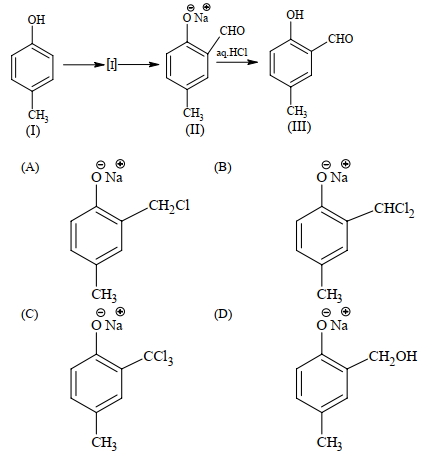
Reimer-Tiemann reaction introduces an aldehyde group, on to the aromatic ring of phenol, ortho to the hydroxyl group. This reaction involves electrophilic aromatic substitution. This is a general method for the synthesis of substituted salicyladehydes as depicted below.

$Image$

$1.$ Which one of the following reagents is used in the above reaction?

$(A)$ aq. $\mathrm{NaOH}+\mathrm{CH}_3 \mathrm{Cl}$

$(B)$ aq. $\mathrm{NaOH}+\mathrm{CH}_2 \mathrm{Cl}_2$

$(C)$ aq. $\mathrm{NaOH}+\mathrm{CHCl}_3$

$(D)$ aq. $\mathrm{NaOH}+\mathrm{CCl}_4$

$2.$ The electrophile in this reaction is

$(A)$ : $\mathrm{CHCl}$ $(B)$ ${ }^{+} \mathrm{CHCl}_2$

$(C)$ $\mathrm{CCl}_2$ $(D)$. $\mathrm{CCl}_3$

$3.$ The structure of the intermediate $I$ is

$Image$

Give the answer question $1, 2$ and $3.$

If the CFSE of $\left[ Ti \left( H _2 O \right)_6\right]^{3+}$ is $-96.0\,kJ / mol$, this complex will absorb maximum at wavelength $........nm$. (nearest integer)

Assume Planck's constant $( h )=6.4 \times 10^{-34}\,Js$ Speed of light $( c )=3.0 \times 10^8\,m / s$ and Avogadro's constant $\left( N _{ A }\right)=6 \times 10^{23} / mol$

Glucose does not react with
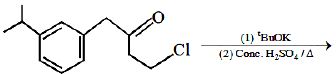
The major product of the following reaction is
Of the following complexes, the one with the largest value of crystal field splitting energy is
Which shows polymorphism
The main function of a catalyst in speeding up a reaction is
Nitrogen can exhibit which of the following oxidation states:
Which of the following will have three stereoisomeric forms 

$(i)$ $[Cr(NO_3)_3(NH_3)_3]$

$(ii)$ $K_3[Co(C_2O_4)_3]$

$(iii)$ $K_3 [CoCl_2(C_2O_4)_2]$

$(iv)$ $[Co BrCl(en)_2]$

Electronic configuration of $Cu(Z = 29)$ is