MCQ
The correct formula of borax is
  • A
    $Na_2[B_4O_4(OH)_3].9 H_2O$
  • $Na_2[B_4O_5(OH)_4].8 H_2O$
  • C
    $Na_2[B_4O_6(OH)_5].7 H_2O$
  • D
    $Na_2[B_4O_7(OH)_6].6 H_2O$

Answer

Correct option: B.
$Na_2[B_4O_5(OH)_4].8 H_2O$
b
Borax is sodium tetraborate decahydrate i.e. $Na_2[B_4O_5(OH)_4].8H_2O$

Need a full question paper?

Generate a complete, print-ready paper with questions like this in minutes — across 16+ boards, with answer keys.

Start Generating Free

Similar questions

The alkene that exhibits geometrical isomerism is :
Nitrogen is obtained when $NaN{O_2}$ reacts with
Arrange these compounds in decreasing order of reactivity for the nucleophilic addition reaction :

$(I)$ Acid chloride                   $(II)$ Aldehyde

$(III)$ Ketone                          $(IV)$ Ester

Select the correct answer from the codes given below :

A sample of $N{a_2}C{O_3}.{H_2}O$ weighing $0.62\,\,g$ is added to $100\,\,ml$ of $0.1\,N\;\;{(N{H_4})_2}S{O_4}$ solution. What will be the resulting solution
Equilibrium constant $(K_c)$ of $2HI_{(g)}  \rightleftharpoons  H_{2(g)} + I_{2(g)}$ is $5\times10^3$. What is the equilibrium concentration of $HI$, if equilibrium concentrations of $H_{2(g)}$ and $I_{2(g)}$ respectively are $2.2\times10^{-2}\, M$ and $2.2\times10^{-4}\, M$ ?
The enthalpy changes for the following processes are listedbelow :

$Cl_2(g) \rightarrow 2Cl(g),$ $242.3\,kJ\,mol^{-1}$
$I_2(g) \rightarrow 2I(g),$ $151.0\,kJ\,mol^{-1}$
$ICl(g) \rightarrow I(g)+Cl(g),$ $211.3\,kJ\,mol^{-1}$
$I_2(s) \rightarrow I_2(g),$ $62.76\,kJ\,mol^{-1}$

Given that the standard states for iodine and chlorine are $I_2(s)$ and $Cl_2(g),$ the standard enthalpy of formation for $ICl(g)$ is : ............... $\mathrm{kJ\,mol}^{-1}$

Optical activity of an enantiomeric mixture is $+12.6^{\circ}$ and the specific rotation of $(t)$ isomer is $+30^{\circ}$. The optical purity is $........\%$
If an iron rod is dipped in $CuS{O_4}$ solution
Assertion : $C -O$ bond in metal carbonyls is long.

Reason : There is delocalisation of electrons from filled $d$ orbitals into the empty orbitals on the $CO$ ligands.

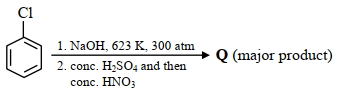
The weight percentage of hydrogen in $Q$, formed in the following reaction sequence, is. . . . 

[Given : Atomic mass of $H =1, C =12, N =14, O =16, S =32, Cl =35$ ]