The correct increasing order for modulus of elasticity for copper, steel, glass and rubber is
Easy


Download our appand get started for free
Experience the future of education. Simply download our apps or reach out to us for more information. Let's shape the future of learning together!No signup needed.*
Similar Questions
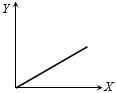
- 1A student plots a graph from his reading on the determination of Young’s modulus of a metal wire but forgets to label. The quantities on $X$ and $Y$ axes may be respectively.View Solution
- 2A uniform copper rod of length $50 \,cm$ and diameter $3.0 \,mm$ is kept on a frictionless horizontal surface at $20^{\circ} C$. The coefficient of linear expansion of copper is $2.0 \times 10^{-5} \,K ^{-1}$ and Young's modulus is $1.2 \times 10^{11} \,N / m ^2$. The copper rod is heated to $100^{\circ} C$, then the tension developed in the copper rod is .......... $\times 10^3 \,N$View Solution
- 3View SolutionOn stretching a wire, the elastic energy stored per unit volume is
- 4The ratio of two specific heats of gas ${C_p}/{C_v}$ for argon is $1.6$ and for hydrogen is $1.4$. Adiabatic elasticity of argon at pressure $P$ is $E.$ Adiabatic elasticity of hydrogen will also be equal to $E$ at the pressureView Solution
- 5View SolutionThe Bulk Modulus for an incompressible liquid is
- 6A horizontal steel railroad track has a length of $100 \,m$, when the temperature is $25^{\circ} C$. The track is constrained from expanding or bending. The stress on the track on a hot summer day, when the temperature is $40^{\circ} C$ is ............. $\times 10^7\,Pa$ (Note : The linear coefficient of thermal expansion for steel is $1.1 \times 10^{-5} /{ }^{\circ} C$ and the Young's modulus of steel is $2 \times 10^{11} \,Pa$ )View Solution
- 7The ratio of Young's modulus of the material of two wires is $2 : 3.$ If the same stress is applied on both, then the ratio of elastic energy per unit volume will beView Solution
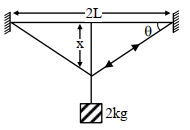
- 8A wire of cross sectional area $A$, modulus of elasticity $2 \times 10^{11} \mathrm{Nm}^{-2}$ and length $2 \mathrm{~m}$ is stretched between two vertical rigid supports. When a mass of $2 \mathrm{~kg}$ is suspended at the middle it sags lower from its original position making angle $\theta=\frac{1}{100}$ radian on the points of support. The value of $A$ is. . . . . . $\times 10^{-4} \mathrm{~m}^2$ (consider $\mathrm{x}<\mathrm{L}$ ).View Solution
(given: $\mathrm{g}=10 \mathrm{~m} / \mathrm{s}^2$ )
- 9Two separate wires $A$ and $B$ are stretched by $2 \,mm$ and $4\, mm$ respectively, when they are subjected to a force of $2\, N$. Assume that both the wires are made up of same material and the radius of wire $B$ is 4 times that of the radius of wire $A$. The length of the wires $A$ and $B$ are in the ratio of $a : b$. Then $a / b$ can be expressed as $1 / x$ where $x$ isView Solution
- 10A wire of area of cross-section $10^{-6}\,m^2$ is increased in length by $0.1\%$. The tension produced is $1000\, N$. The Young's modulus of wire isView Solution