MCQ
The correct order of decreasing basic strength of the above compounds is
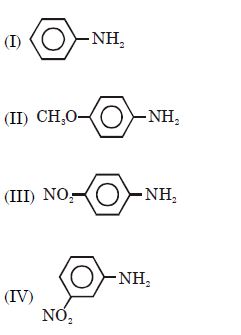
- A$I > II > III > IV$
- ✓$II > I > IV > III$
- C$III > IV > II > I$
- D$II > I > III > IV$
Generate a complete, print-ready paper with questions like this in minutes — across 16+ boards, with answer keys.
| Exp. | $[A]$ | $[B_2]$ | Rate $(mol\,L^{-1}\,S^{-1})$ |
| $1$ | $0.50$ | $0.50$ | $1.6 \times {10^{ - 4}}$ |
| $2$ | $0.50$ | $1.00$ | $3.2 \times {10^{ - 4}}$ |
| $3$ | $1.00$ | $1.00$ | $3.2 \times {10^{ - 4}}$ |
The rate law
${E^o}_{\left( {{I_2}/{I^ - }} \right)},{E^ \circ }_{\left( {Br^-/B{r_2}} \right)}$ and ${E^ o }_{\left( {{Fe}/{Fe^{2+} }} \right)}$
are respectively $+ 0.54\ V$, $-1.09\ V$ and $0.44\ V$. On the basis of above data which of the following process is non-spontaneous
$Cu^{2+}_{(aq)} + e^- \rightarrow Cu^+_{(aq)}$ and $Cu^+_{(aq)} + e^- \rightarrow Cu_{(s)}$ are $+ 0.15\, V$ and $+ 0.50\, V$ respectively. The value of $E^o_{Cu^{2+}/Cu}$ will be ........ $V$