MCQ
The correct order of enol contents $x, y, z$ is
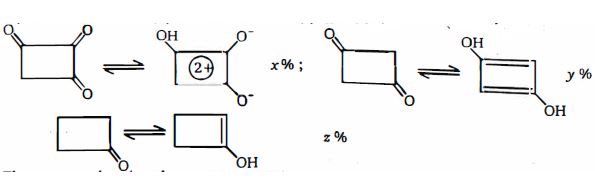
- A$x > y > z$
- B$z > y > x$
- C$y > x > z$
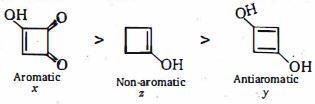
- ✓$x > z > y$
Generate a complete, print-ready paper with questions like this in minutes — across 16+ boards, with answer keys.
$C(s)\, + \,C{O_2}(g)\, \rightleftharpoons \,2CO(g),$
the partial pressure of $CO_2$ and $CO$ are $2.0$ and $4.0 \,atm$, respectively, at equilibrium. The $k_p$ of the reaction is
$(A)$ Uncertainty principle rules out the existence of definite paths for electrons.
$(B)$ The energy of an electron in $2 s$ orbital of an atom is lower than the energy of an electron that is infinitely far away from the nucleus.
$(C)$ According to Bohr's model, the most negative energy value for an electron is given by $n=1$, which corresponds to the most stable orbit.
$(D)$ According to Bohr's model, the magnitude of velocity of electrons increases with increase in values of $n$.