MCQ
The correct relation between limit of resolution and resolving power is
  • Limit of resolution $= \frac{1}{resolving\, power}$
  • B
    Limit of resolution $\propto$ resolving power
  • C
    Limit of resolution $\propto \, \frac{1}{resolving\, power}$
  • D
    Limit of resolution $\propto$ ($1$ -resolving power)
Answer

Correct option: A.
Limit of resolution $= \frac{1}{resolving\, power}$
a
Limit of resolution $= \frac{1}{resolving\, power}$

Need a full question paper?

Generate a complete, print-ready paper with questions like this in minutes — across 16+ boards, with answer keys.

Start Generating Free

Similar questions

For a particular ideal gas which of the following graphs represents the variation of mean squared velocity of the gas molecules with temperature?
Unlike a laboratory sonometer, a stringed instrument is seldom plucked in the middle. Supposing a sitar string is plucked at about $\frac{1}{4}$th of its length from the end. The most prominent harmonic would be
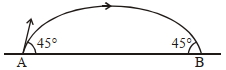
The projectile motion of a particle of mass $5\, g$ is shown in the figure.

The initial velocity of the particle is $5 \sqrt{2}\, ms ^{-1}$ and the air resistance is assumed to be negligible. The magnitude of the change in momentum between the points $A$ and $B$ is $x \times 10^{-2}\, kgms ^{-1} .$ The value of $x ,$ to the nearest integer, is ...... .

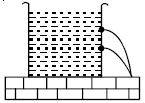
In a cylindrical vessel containing liquid of density $\rho $, there are two holes in the side walls at heights of $ h_1$  and $h_2$ respectively such that the range of efflux at the bottom of the vessel is same. The height of a hole, for which the range of efflux would be maximum, will be
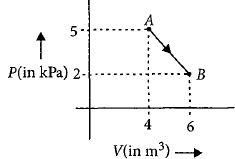
One mole of an ideal diatomic gas undergoes a transition from $A$ to $B$ along a path $AB$ as shown in the figure. 

The change in internal energy of the gas during the transition is ............$\;kJ$

The specific heat of a gas at constant volume is $21.2\, J/mole/°C.$ If the temperature is increased by $1°C$ keeping the volume constant, the change in its internal energy will be ...... $J$
One can define an alpha-volt $(\alpha-V)$ to be the energy acquired by an $\alpha$-particle when it is accelerated by a potential of $1 \,V$. For this problem, you may take a proton to be $2000$ times heavier than an electron. Then,
Two bodies of masses $2\,kg$ and $4\,kg$ are moving with velocities $2\,m/s$ and $10\,m/s$ respectively towards each other due to mutual gravitational attraction. ....... $m/s$ is the velocity of their centre of mass (Bodies are at rest initially)
When an air bubble of radius $‘r’$ rises from the bottom to the surface of a lake, its radius becomes $5r/4$ (the pressure of the atmosphere is equal to the $10 \,m$ height of water column). If the temperature is constant and the surface tension is neglected, the depth of the lake is .... $m$
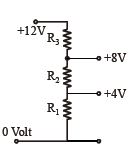
A potential divider is used to give outputs of $4\,V$ and $8\,V$ from a $12\,V$ source. Which combination of resistances, $(R_1 : R_2 : R_3)$ gives the correct voltages