MCQ
The correct relation is
  • $r = \frac{{2T\,\cos \theta }}{{hdg}}$
  • B
    $r = \frac{{hdg}}{{2T\,\cos \theta }}$
  • C
    $r = \frac{{2T\,dgh}}{{\cos \theta }}$
  • D
    $r = \frac{{T\cos \theta }}{{2hdg}}$

Answer

Correct option: A.
$r = \frac{{2T\,\cos \theta }}{{hdg}}$
a
(a) $h=\frac{2 T \cos \theta}{r d g}$

$r=\frac{2 T \cos \theta}{h d g}$

Need a full question paper?

Generate a complete, print-ready paper with questions like this in minutes — across 16+ boards, with answer keys.

Start Generating Free

Similar questions

At $127^o C$ radiates energy is $2.7 \times 10^{-3} J/s$. At ....... $K$ temperature radiated energy is $4.32 \times 10^6 J/s$
A uniform disk of mass $m$ and radius $R$ rolls without slipping down an incline plane of length $l$ and inclination $\theta$. Initially the disk was at rest at the top of the incline plane. Its angular momentum about the point of contact with the inclined plane when it reaches the bottom will be equal to :-
If $10^{22}$ gas molecules each of mass $10^{-26}\, kg$ collide with a surface (perpendicular to it)elastically per second over an area $1\, m^2$ with a speed $10^4\,m/s$, the pressure exerted by the gas molecules will be of the order of
A barometer tube reads $ 76 cm $ of mercury. If the tube is gradually inclined at an angle of $ 60°$  with vertical, keeping the open end immersed in the mercury reservoir, the length of the mercury column will be ........ $cm$
Which statement is incorrect:
Every planet revolves around the sun in an elliptical orbit :

$A.$ The force acting on a planet is inversely proportional to square of distance from sun.

$B.$ Force acting on planet is inversely proportional to product of the masses of the planet and the sun

$C.$ The centripetal force acting on the planet is directed away from the sun.

$D.$ The square of time period of revolution of planet around sun is directly proportional to cube of semi-major axis of elliptical orbit.

Choose the correct answer from the options given below :
Two moles of ideal helium gas are in a rubber balloon at $30^{\circ} C$. The balloon is fully expandable and can be assumed to require no energy in its expansion. The temperature of the gas in the balloon is slowly changed to $35^{\circ} C$. The amount of heat required in raising the temperature is nearly (take $R =8.31 J / mol$. $K$)
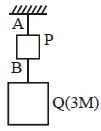
Wires $A$ and $B$ are connected with blocks $P$ and $Q$ as shown. The ratio of lengths, radii and Young's modulus of wires $A$ and $B$ are $r, 2r$ and $3r$ respectively ($r$ is a constant). Find the mass of block $P$ if ratio of increase in their corresponding lengths is $1/6r^2$. The mass of block $Q$ is $3M$.
Which of the following pairs has quantities of the same dimensions?
  1. Magnetic field $B$ and magnetizing field intensity $H.$
  2. Magnetic field $B$ and intensity of magnetization $I.$
  3. Magnetizing field intensity $H$ and intensity of magnetization $I.$
  4. Longitudinal strain and magnetic susceptibility.
The volume of a metal sphere increases by $0.24\%$ when its temperature is raised by $40°C$. The coefficient of linear expansion of the metal is .......... $°C$