MCQ
The correct statement from the following is
  • A body having zero velocity will not necessarily have zero acceleration
  • B
    A body having zero velocity will necessarily have zero acceleration
  • C
    A body having uniform speed can have only uniform acceleration
  • D
    A body having non-uniform velocity will have zero acceleration
Answer

Correct option: A.
A body having zero velocity will not necessarily have zero acceleration
a
(a)When the body is projected vertically upward then at the highest point its velocity is zero but acceleration is not equal to zero $(g = 9.8m/{s^2})$.

Need a full question paper?

Generate a complete, print-ready paper with questions like this in minutes — across 16+ boards, with answer keys.

Start Generating Free

Similar questions

Which of the following can be coefficient of performance of refrigerator?
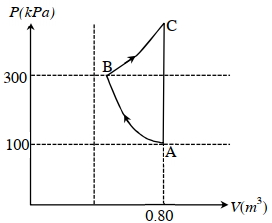
In the given $P$-V diagram, a monoatomic gas $\left(\gamma=\frac{5}{3}\right)$ is first compressed adiabatically from state $A$ to state $B$. Then it expands isothermally from state $B$ to state $C$. [Given: $\left(\frac{1}{3}\right)^{0.6} \simeq 0.5, \ln 2 \simeq 0.7$ ].

Which of the following statement($s$) is(are) correct?

$(A)$ The magnitude of the total work done in the process $A \rightarrow B \rightarrow C$ is $144 kJ$.

$(B)$ The magnitude of the work done in the process $B \rightarrow C$ is $84 kJ$.

$(C)$ The magnitude of the work done in the process $A \rightarrow B$ is $60 kJ$.

$(D)$ The magnitude of the work done in the process $C \rightarrow A$ is zero.

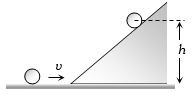
A disc of mass $M$ and radius $R$ rolls in a horizontal surface and then rolls up an inclined plane as shown in the fig. If the velocity of the disc is $v$, the height to which the disc will rise will be..
$Assertion$ : The number of significant figures depends on the least count of measuring instrument.
$Reason$ : Significant figures define the accuracy of measuring instrument.
The compressibility of water is $6 \times 10^{-10} N ^{-1} m ^{2} .$ If one litre is subjected to a pressure of $4 \times 10^{7} Nm ^{-2}$ the decrease in its volume is (in $cc$)
A body under the action of a force $\vec F = 6\hat i - 8\hat j\,N$ acquires an acceleration of $5\, ms^{-2}$. The mass of the body is 
Water enters through end $A$  with speed ${v_1}$ and leaves through end $B$ with speed ${v_2}$ of a cylindrical tube $AB$. The tube is always completely filled with water. In case $I$  tube is horizontal and in case $ II$  it is vertical with end $ A $ upwards and in case $ III $ it is vertical with end $B$ upwards. We have ${v_1} = {v_2}$ for
If for two vectors $\overrightarrow A $ and $\overrightarrow B ,\overrightarrow A \times \overrightarrow B = 0,$ the vectors
A particle is projected vertically upwards with a speed of $16\  m/s$ , after some time , when it again passes through the point of projection, its speed is found to be $8\  m/s$ . It is known that the work done by air resistance is same during upward and downward motion. Then the maximum height attained by the particle is ...................... $\mathrm{m}$ ( $g$ = $10\  m/s^2$ )
A particle is moving with speed $v= b\sqrt x$ along positive $x-$ axis. Calculate the speed of the particle at time $t = \tau$ (assume that the particle is at origin at $t = 0$ ).