MCQ
The correct statement from the following is
  • A body having zero velocity will not necessarily have zero acceleration
  • B
    A body having zero velocity will necessarily have zero acceleration
  • C
    A body having uniform speed can have only uniform acceleration
  • D
    A body having non-uniform velocity will have zero acceleration
Answer

Correct option: A.
A body having zero velocity will not necessarily have zero acceleration
(a) When the body is projected vertically upward then at the highest point its velocity is zero but acceleration is not equal to zero $\left(g=9.8 \mathrm{~m} / \mathrm{s}^2\right)$.

Need a full question paper?

Generate a complete, print-ready paper with questions like this in minutes — across 16+ boards, with answer keys.

Start Generating Free

Similar questions

A bar magnet of length $10 \mathrm{~cm}$ and having the pole strength equal to $10.$ weber is kept in a magnetic field having magnetic induction $(B)$ equal to $4 \pi \times 10^{-3}$ Tesla. It makes an angle of $30$ with the direction of magnetic induction. The value of the torque acting on the magnet is $\left(\mu_0=4 \pi \times 10^{-7}\right.$ weber / amp $\left.\times \mathrm{m}\right)$
The volume of air increases by $5 \%$ in its adiabatic expansion. The percentage decrease in its pressure will be
The length of an iron wire is $L$ and area of cross-section is $A$. The increase in length is $l$ on applying the force $F$ on its two ends. Which of the statement is correct
Which pair of the following forces will never give resultant force of $2 N$
An object accelerates from rest to a velocity $27.5 m / s$ in $10 sec$ then find distance covered by object in next $10 sec$
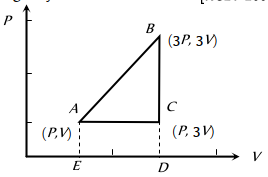
An ideal gas is taken around $\text{ABCA}$ as shown in the above $\text{P-V}$ diagram. The work done during a cycle is Image
An object is placed infront of a convex mirror at a distance of 50 $\mathrm{cm}$. A plane mirror is introduced covering the lower half of the convex mirror. If the distance between the object and plane mirror is $30 \mathrm{~cm}$, it is found that there is no parallax between the images formed by two mirrors. Radius of curvature of mirror will be
Find the luminous intensity of the sun if it produces the same illuminance on the earth as produced by a bulb of $10000$ candela at a distance $0.3 \mathrm{~m}$. The distance between the sun and the earth is $1.5 \times 10^{11} \mathrm{~m}$
A man is carrying a block of a certain substance (of density 1000 $kgm ^{-3}$ ) weighing $1 kg$ in his left hand and a bucket filled with water and weighing $10 kg$ in his right hand. He drops the block into the bucket. How much load does he carry in his right hand now
The pressure and density of a diatomic gas $(\gamma=7 / 5)$ change adiabatically from $(P, d)$ to $(P, d)$. If $\frac{d^{\prime}}{d}=32$, then $\frac{P^{\prime}}{P}$ should be