MCQ
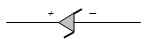
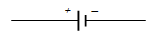
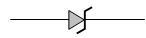
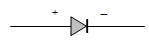
The correct symbol for zener diode is
 
  • B
  • C
  • D

Answer

Correct option: A.

Need a full question paper?

Generate a complete, print-ready paper with questions like this in minutes — across 16+ boards, with answer keys.
Start Generating Free

Similar questions

$H^+,He^+$ and $O^{++}$ ions having same kinetic energy pass through a region of space filled with uniform magnetic field B directed perpendicular to the velocity of ions. The masses of the ions $H^+,He^+$ and $O^{++}$ are respectively in the ratio 1 : 4 : 16. As a result
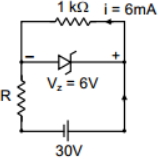
If voltage across zener diode is $6\, V$ then find out value of maximum resistance in this condition. (in $k \Omega$)
An $AC$ source is rated $220V, 50Hz.$ The average voltage is calculated in a time interval of $0.01s$, It:
The free electron density is more in $.....:$
In a potentiometer experiment the balancing with a cell is at length $240\,cm$ . On shunting the cell with a resistance of $2\,\Omega $ , the balancing length becomes $120\, cm$ . The internal resistance of the cell is ................... $\Omega$
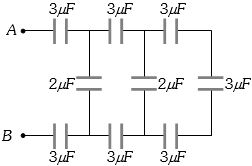
The resultant capacitance between $A$ and $B$ in the following figure is equal to.....$\mu F$
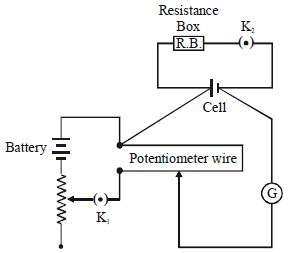
The adjoining figure shows the connections of potentiometer experiment to determine internal resistance of of a leclanche cell. When the cell is on open circuit the balancing length of the potentiometer wire is $3.4\, m$ and on closing the key $K_2$ the balancing length becomes $1.7\, m$ . If the resistance $R$ through which current is drawn is $10\,\Omega $ then the internal resistance of the cell is .............. $\Omega$
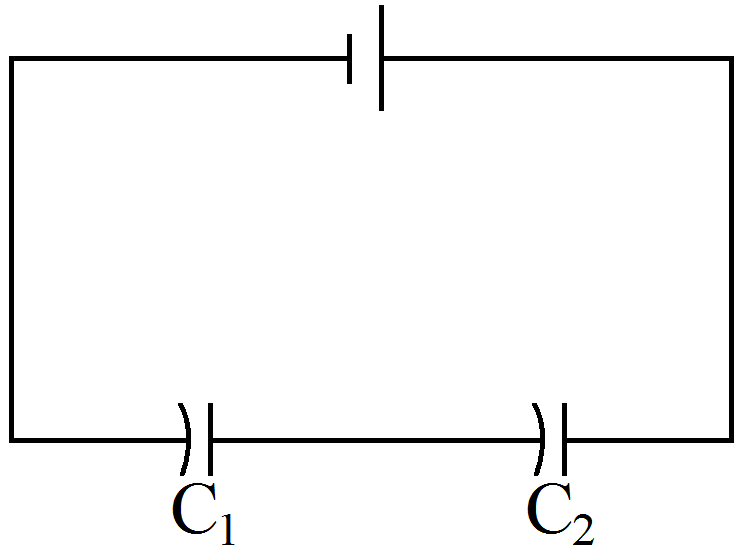
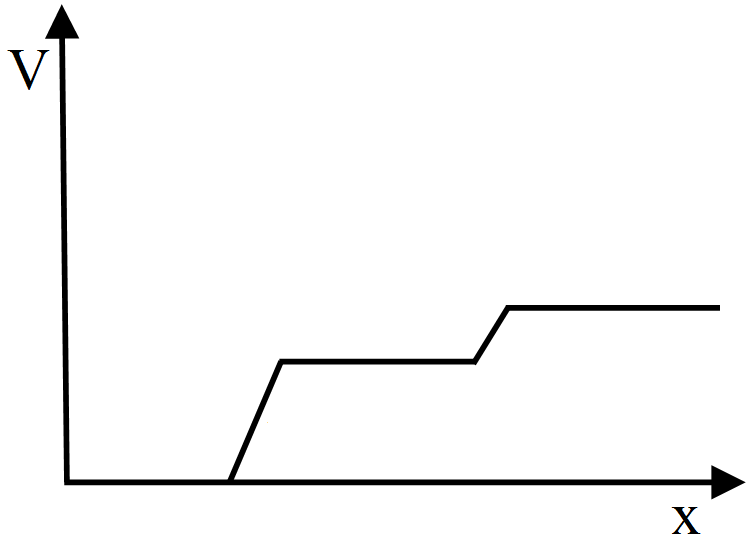
Figure shows two capacitors connected in series and joined to a battery. The graph shows the variation in potential as one moves from left to right on the branch containing the capacitors:
Consider four conducting materials copper, tungsten, mercury and aluminium with resistivity $\rho_{ C }, \rho_{ T }, \rho_{ M }$ and $\rho_{ A }$ espectively Then:
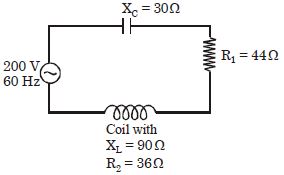
As given in the figure, a series circuit connected across a $200 \,V, 60\, Hz$ line consists of a capacitor of capacitive reactance $30 \,\Omega$, a non-inductive resistor of  $44\, \Omega$, and a coil of inductive reactance $90\,  \Omega$ and resistance $36\, \Omega$. The power dissipated in the coil is.....$W$