Question
The count rate from a radioactive sample falls from 4.0 × 10⁶ per second to 1.0 × 10per second in 20 hours. What will be the count rate 100 hours after the beginning?

Answer

$\text{A}_0=4\times10^5$ disintegration/sec

$\text{A}'=1\times10^6$ dis/sec; t = 20 hours.

$\text{A}'=\frac{\text{A}_0}{2^{\frac{\text{t}}{\text{t}_{\frac{1}{2}}}}}\Rightarrow2^{\frac{\text{t}}{\text{t}_{\frac{1}{2}}}}=\frac{\text{A}_0}{\text{A}'}\Rightarrow2^{\frac{\text{t}}{\text{t}_{\frac{1}{2}}}}=4$

$\Rightarrow\frac{\text{t}}{\text{t}_{\frac{1}{2}}}=2\Rightarrow\text{t}^{\frac{1}{2}}=\frac{\text{t}}{2}=\frac{20\text{ hours}}{2}=10\text{ hours}.$

$\text{A}''=\frac{\text{A}_0}{2^{\frac{\text{t}}{\text{t}_{\frac{1}{2}}}}}\Rightarrow\text{A}''=\frac{4\times10^6}{2^{\frac{100}{10}}}$

$=0.00390625\times10^6=3.9\times10^3$ dintegrations/sec.

Need a full question paper?

Generate a complete, print-ready paper with questions like this in minutes — across 16+ boards, with answer keys.
Start Generating Free

Similar questions

A thin but long, hollow, cylindrical tube of radius r carries a current i along its length. Find the magnitude of the magnetic field at a distance $\frac{\text{r}}{2}$ from the surface (a) inside the tube (b) outside the tube.
Two identically charged particles are fastened to the two ends of a spring of spring constant 100Nm-1 and natural length 10cm. The system rests on a smooth horizontal table. If the charge on each particle is 2.0 × 10-8C, find the extension in the length of the spring. Assume that the extension is small as compared to the natural length. Justify this assumption after you solve the problem.
Find the magnetic field B due to a semicircular wire of radius 10.0cm carrying a current of 5.0A at its centre of curvature.
A hydrogen atom in state n = 6 makes two successive transitions and reaches the ground state. In the first transition a photon of 1.13eV is emitted. (a) Find the energy of the photon emitted in the second transition (b) What is the value of n in the intermediate state?
An $\alpha$-particle and a proton moving with the same speed enter the same magnetic field region at right angles to the direction of the field. Show the trajectories followed by the two particles in the region of the magnetic field. Find the ratio of the radii of the circular paths which the two particles may describe.

Is it easier to take out a nucleon from carbon or from iron? Fi-om iron or from lead?
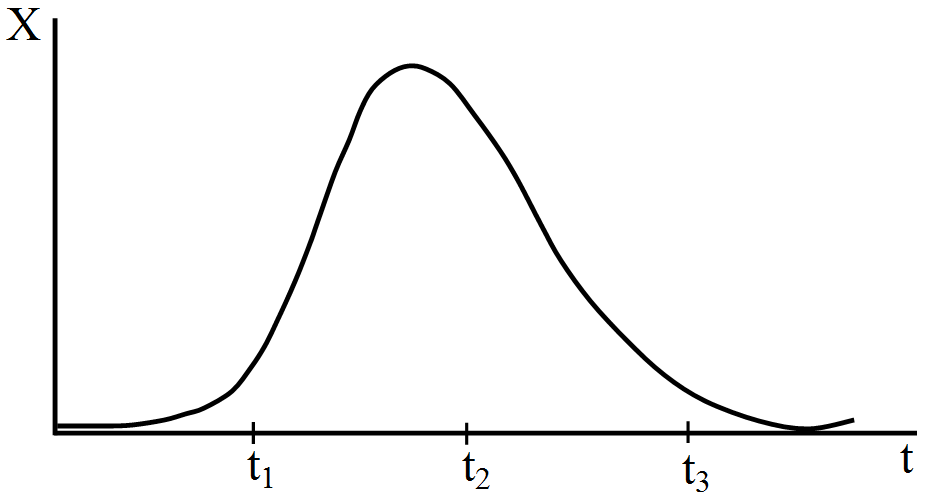
Figure shows the x coordinate of a particle as a function of time. Find the signs of vx and ax at t = t1, t = t2 and t = t3.

A person travelling by a car moving at 100km/h finds that his wristwatch agrees with the clock on a tower A. By what amount will his wristwatch lag or lead the clock on another tower B, 1000km (in the earth's frame) from the tower A when the car reaches there?
A beam of light converges at a point P. Now a lens is placed in the path of the convergent beam 12cm from P. At what point does the beam converge if the lens is (a) a convex lens of focal length 20cm, and (b) a concave lens of focal length 16cm?
A swimmer wishes to cross a 500m wide river flowing at 5km/h. His speed with respect to water is 3km/h.
  1. If he heads in a direction making an angle 0 with the flow, find the time he takes to cross the river.
  2. Find the shortest possible time to cross the river.