Question
The count rate from a radioactive sample falls from $4.0 \times 10^6$ per second to $1.0 \times 10^6$ per second in 20 hours. What will be the count rate 100 hours after the beginning?

Answer

$\text{A}_0=4\times10^5$ disintegration/sec$\text{A}'=1\times10^6$ dis/sec; t = 20 hours.
$\text{A}'=\frac{\text{A}_0}{2^{\frac{\text{t}}{\text{t}_{\frac{1}{2}}}}}\Rightarrow2^{\frac{\text{t}}{\text{t}_{\frac{1}{2}}}}=\frac{\text{A}_0}{\text{A}'}\Rightarrow2^{\frac{\text{t}}{\text{t}_{\frac{1}{2}}}}=4$
$\Rightarrow\frac{\text{t}}{\text{t}_{\frac{1}{2}}}=2\Rightarrow\text{t}^{\frac{1}{2}}=\frac{\text{t}}{2}=\frac{20\text{ hours}}{2}=10\text{ hours}.$
$\text{A}''=\frac{\text{A}_0}{2^{\frac{\text{t}}{\text{t}_{\frac{1}{2}}}}}\Rightarrow\text{A}''=\frac{4\times10^6}{2^{\frac{100}{10}}}$
$=0.00390625\times10^6=3.9\times10^3$ dintegrations/sec.

Need a full question paper?

Generate a complete, print-ready paper with questions like this in minutes — across 16+ boards, with answer keys.
Start Generating Free

Similar questions

Explain the parallel connection of capacitors.
Calculate the height of the potential barrier for a head on collision of two deuterons. (Hint: The height of the potential barrier is given by the Coulomb repulsion between the two deuterons when they just touch each other. Assume that they can be taken as hard spheres of radius 2.0 fm.)
$(II) \ (a)$ Define electric flux and write its SI unit.
$(b)$ Use Gauss᾿s law to obtain the expression for the electric field due to a uniformly charged infinite plane sheet of charge.
Can we perform Young's double slit experiment with sound waves? To get a reasonable "fringe pattern", what should be the order of separation between the slits? How can the bright fringes and the dark fringes be detected in this case?
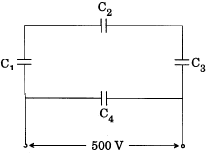
A network of four capacitors each of 12 μF capacitance is connected to a 500 V supply as shown in the figure. Determine (a) equivalent capacitance of the network and (b) charge on each capacitor.
The moon takes about 27.3 days to revolve round the earth in a nearly circular orbit of radius $3.84 x 10^5km$. Calculate the mass of the earth from these data.
From the relation $\text{R}=\text{R}_0\text{A}^{1/3}$ where $R_0$ is a constant and A is the mass number of a nucleus, show that the nuclear matter density is nearly constant (i.e. independent of A).
State Biot – Savart law. Deduce the expression for the magnetic field at a point on the axis of a current carrying circular loop of radius ‘R’, distant ‘x’ from the centre. Hence write the magnetic field at the centre of a loop.
A particle starts from the origin, goes along the X-axis to the point (20m, 0) and then returns along the same line to the point (-20m, 0). Find the distance and displacement of the particle during the trip.
A short bar magnet has a magnetic moment of $0.48\ J\ T^{–1}$. Give the direction and magnitude of the magnetic field produced by the magnet at a distance of 10 cm from the centre of the magnet on.(a) the axis, (b) the equatorial lines (normal bisector) of the magnet.