Question
Explain the parallel connection of capacitors.

Answer

Image
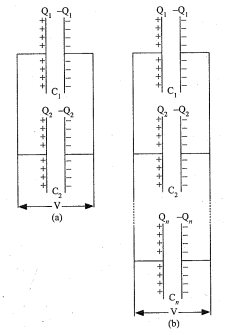
$\rightarrow$ As shown in the fig. $(a)$ two capacitors $C _1$ and $C _2$ are connected in parallel.
$\rightarrow$ For such connection, the $p.d$. across each capacitor is same, suppose its value is $V$ .
$\rightarrow$ The charge on the plate of capacitor $' 1\ '$ is $\left(+Q_1\right)$ and the charge on the plate of capacitor $' 2 '$ is $\left(+Q_2\right)$
$\rightarrow Q=C V$ for first capacitor $Q_1=C_1 V$ and for second capacitor $Q _2= C _2 V$
$\rightarrow$​​​​​​​ Hence, the total charge $($ charge of the equivalent capacitor$)$
$Q =Q_1+Q_2$
$\therefore Q =C_1 V+C_2 V$
$\therefore Q =V\left(C_1+C_2\right)$
$\therefore \frac{Q}{V} =C_1+C_2$
$\rightarrow$​​​​​​​ Suppose, the equivalent capacitance for the given parallel connection is $C$ .
$\therefore C =\frac{ Q }{ V } \ldots$
$\therefore C = C _1+ C _2 \ ($From $(1)$ and $(2))$
$\rightarrow $ As shown in fig.$ (b), C_1, C_2, C_3 \ldots . . C_n$ total $n$ capacitors are connected in parallel. $P.d$. for each is $V$ and the charge on each capacitor is $Q _1, Q _2, Q _3 \ldots . . Q _n$
$\rightarrow$ Hence, the total charge,
$Q=Q_1+Q_2+Q_3+\ldots .+Q_n$
$\therefore Q = C _1 V+ C _2 V+ C _3 V+\ldots .+ C _n V$
$\therefore \frac{ Q }{ V }= C _1+ C _2+ C _3+\ldots . .+ C _n$
$\rightarrow$​​​​​​​ Suppose, the equivalent capacitance for the given parallel connection is $C$ .
Where $\therefore C =\frac{ Q }{ V }$
$\rightarrow$​​​​​​​ So, from eq $(3)$ and $(4),$
$\rightarrow C = C _1+ C _2+ C _3+\ldots . .+ C _n$
$\rightarrow$ Suppose, the capacitance of each capacitor is same and it is ' $C ^{\prime}$
$\therefore$ Equivalent capacitance,
$C _{e q} = C + C + C +\ldots . .+ C \text { (n times) }$
$\therefore \left( C _{e q}\right. =n C )$

Need a full question paper?

Generate a complete, print-ready paper with questions like this in minutes — across 16+ boards, with answer keys.
Start Generating Free

Similar questions

A beam of light having wavelengths distributed uniformly between 450nm to 550nm passes through a sample of hydrogen gas. Which wavelength will have the least intensity in the transmitted beam?
Find the range of frequency of light that is visible to an average human being $(400\text{nm}<\lambda<700\text{nm}).$
In Bohr’s theory of hydrogen atom, calculate the energy of the photon emitted during a transition of the electron from the first excited state to the ground state. Write in which region of the electromagnetic spectrum this transition lies.
$i.$ Draw a plot showing the variation of potential energy of a pair of nucleons as a function of their separation. Mark the regions where the nuclear force is
$a.$ attractive and
$b.$ repulsive.
$ii.$ In the nuclear reaction ${ }_0 n^1+{ }_{92}^{235} U \rightarrow_{54}^a Xe +{ }_b^{94} Sr +2{ }_0 n^1$ determine the values of $a$ and $b.$
A block of mass 30.0kg is being brought down by a chain. If the block acquires a speed of 40.0cm/s in dropping down 2.00m, find the work done by the chain during the process.
According to the station clocks, two babies are born at the same instant, one in Howrah and other in Delhi.
  1. Who is elder in the frame of 2301 Up Rajdhani Express going from Howrah to Delhi?
  2. Who is elder in the frame of 2302 Dn Rajdhani Express going from Delhi to Howrah.
Two particles have equal masses of 5.0g each and opposite charges of $+4.0 \times 10^{-5}\ C$ and $-4.0 \times 10^{-5}C$. They are released from rest with a separation of 1.0m between them. Find the speeds of the particles when the separation is reduced to 50cm.
Explain why the reactance offered by an inductor increases with increasing frequency of an alternating voltage.
What is the nature of electrostatic force between two point electric charges $q_1$ and $q_2$ if:
  1. $q_1 + q_2 > 0?$
  2. $q_1 + q_2 < 0?$
A resistor of $200 \Omega$ and a capacitor of $15.0 \mu F$ are connected in series to a $220 V , 50 Hz \ ac$ source. $(a)$ Calculate the current in the circuit; $(b)$ Calculate the voltage $\text{(rms)}$ across the resistor and the capacitor. Is the algebraic sum of these voltages more than the source voltage? If yes, resolve the paradox.