Question
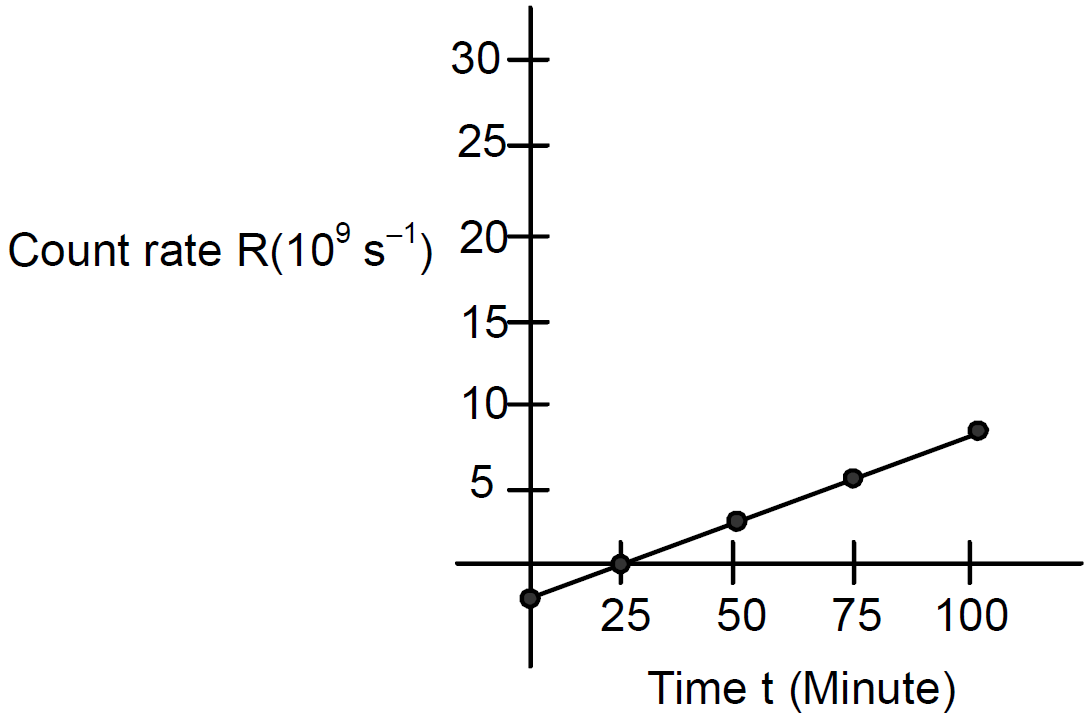
The count rate of nuclear radiation coming from a radiation coming from a radioactive sample containing $^{128}I$ varies with time as follows.
Time t(minute): $0$ $25$ $50$ $75$ $100$
Ctount rate $R(10^9s^{-1}):$ $30$ $16$ $8.0$ $3.8$ $2.0$
  1. Plot In $\Big(\frac{\text{R}_0}{\text{R}}\Big)$ against t.
  2. From the slope of the best straight line through the points, find the decay constant $\lambda.$
  3. Calculate the half-life $\text{t}_{\frac{1}{2}}.$
Answer

  1. Here we should take $R_0$​​​​​​​ at time is $t_0 = 30 \times 10^9s^{-1}​​​​​​​$​​​​​​​
  1. $\text{ln}\Big(\frac{\text{R}_0}{\text{R}_1}\Big)=\text{ln}\Big(\frac{30\times10^9}{30\times10^9}\Big)=0$
  2. $\text{ln}\Big(\frac{\text{R}_0}{\text{R}_2}\Big)=\text{ln}\Big(\frac{30\times10^9}{16\times10^9}\Big)=0.63$
  3. $\text{ln}\Big(\frac{\text{R}_0}{\text{R}_3}\Big)=\text{ln}\Big(\frac{30\times10^9}{8\times10^9}\Big)=1.35$
  4. $\text{ln}\Big(\frac{\text{R}_0}{\text{R}_4}\Big)=\text{ln}\Big(\frac{30\times10^9}{3.8\times10^9}\Big)=2.06$
  5. $\text{ln}\Big(\frac{\text{R}_0}{\text{R}_5}\Big)=\text{ln}\Big(\frac{30\times10^9}{2\times10^9}\Big)=2.7$
  1. $\therefore$ The decay constant $\lambda=0.028\text{min}^{-1}$
  2. $\therefore$ The half life period $\text{t}_{\frac{1}{2}}$
$\text{t}_{\frac{1}{2}}=\frac{0.693}{\lambda}=\frac{0.693}{0.028}=25\text{min}.$

Need a full question paper?

Generate a complete, print-ready paper with questions like this in minutes — across 16+ boards, with answer keys.

Start Generating Free

Similar questions

A particle falling vertically from a height hits a plane surface inclined to horizontal at an angle $\theta$ with speed $\text{v}_0$ and rebounds elastically. Find the distance along the plane where if will hit second time.
(Hint:
  1. After rebound, particle still has speed Vo to start.
  2. Work out angle particle speed has with horizontal after it rebounds.
  3. Rest is similar to if particle is projected up the incline.
A spring compressed by 0.1m develops a restoring force 10N. A body of mass 4kg placed on it. Deduce
  1. The force constant of the spring.
  2. The depression of the spring under the weight of the body(take g = 10 N/ kg).
  3. The period of oscillation, the body is distributed and.
  4. Frequency of oscillation.
Prove that the path of one projectile as seen from another projectile is a straight line.
Find the speed at which the kinetic enei:gy of a particle will differ by 1% from its nonrelativistic value $\frac{1}{2}\text{m}_0\text{v}^2$
State Newton's Second law of motion. Prove that second law is the real law of motion.
Identical springs of steel and copper are equally stretched. On which, more work will have to be done?
Show that the gravitational potential at a point of distant r from the mass M is given by, $\text{V}=-\Big(\frac{\text{GM}}{\text{r}}\Big)$
A disc of radius R is rotating with an angular speed $\omega_\text{o}$ about a horizontal axis. It is placed on a horizontal table. The coefficient of kinetic friction is $\mu_\text{k}{:}$
  1. What was the velocity of its centre of mass before being brought in contact with the table?
  2. What happens to the linear velocity of a point on its rim when placed in contact with the table?
  3. What happens to the linear speed of the centre of mass when disc is placed in contact with the table?
  4. Which force is responsible for the effects in (b) and (c).
  5. What condition should be satisfied for rolling to begin?
  6. Calculate the time taken for the rolling to begin.
Demonstrate free forced and resonant oscillations.