MCQ
The current flow in a Zener diode is mainly due to
  • A
    Thermally generated charge carriers
  • B
    Minority charge carriers
  • Collision generated charge carriers
  • D
    Ions

Answer

Correct option: C.
Collision generated charge carriers
When the reverse bias breakdown voltage is exceeded, a conventional diode is subject to high current due to avalanche breakdown.
Avalanche breakdown occurs in reverse bias when the applied voltage is high enough, the free electron may move fast enough to knock other electrons free, creating more free$-$electron$-$hole pairs $($i.e., more charge carriers$)$, increasing the current.
Thus, the current flow in a Zener diode is mainly due to collision generated charge carriers.

Need a full question paper?

Generate a complete, print-ready paper with questions like this in minutes — across 16+ boards, with answer keys.
Start Generating Free

Similar questions

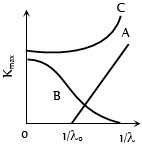
The correct graph between the maximum energy of a photoelectron and the inverse of wavelength of the incident radiation is given by the curve
A mark at the bottom of a liquid appears to rise by $0.1 m.$ The depth of the liquid is $1\, m$. The refractive index of the liquid is
Two identical conductors of copper and aluminium are placed in an identical electric fields. The magnitude of induced charge in the aluminium will be
The primary purpose of using a parabolic mirror in a reflecting telescope is
A diver at a depth of 12 m in water $(\mu=4 / 3)$ sees the sky in a cone of semi-vertical angle
In the lowest energy level of hydrogen atom, the electron has the angular momentum
A $60\; pF$ capacitor is fully charged by a $20\; \mathrm{V}$ supply. It is then disconnected from the supply and is connected to another uncharged $60 \;pF$ capactior is parallel. The electrostatic energy that is lost in this process by the time the charge is redistributed between them is (in $nJ$)
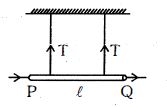
A conducting bar $PQ$ of length $l$ carrying current $I$ is suspended from a rigid support as shown in figure. A uniform magnetic field $B$ perpendicular to $PQ$ and directed away from the reader (inside the plane) is applied. If the mass of the bar is $M$ the tension in each string is
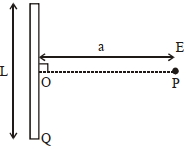
Find the electric field at point $P$ (as shown in figure) on the perpendicular bisector of a uniformly charged thin wire of length $L$ carrying a charge $Q.$ The distance of the point $P$ from the centre of the rod is $a=\frac{\sqrt{3}}{2} L$.
Two points $P$ and $Q$ are maintained at the potentials of $10\, V$ and $-4\,V$, respectively. The work done in moving $100$ electrons from $P$ and $Q$ is