MCQ
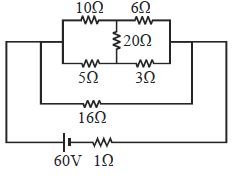
The current from the cell for the given circuit is ................ $\mathrm{A}$
  • $12$
  • B
    $6$
  • C
    $4$
  • D
    None

Answer

Correct option: A.
$12$
a
$\mathrm{R}_{\mathrm{eff}}=[(10+6)\|(5+3)\| 16\, \Omega] \,\mathrm{s} \,1\, \Omega$

$\mathrm{R}_{\mathrm{eff}}=5 \,\Omega$

Hence $\mathrm{I}=\frac{\mathrm{E}}{\mathrm{R}_{\mathrm{eff}}}=\frac{60}{5}=12 \mathrm{\,A}$

Need a full question paper?

Generate a complete, print-ready paper with questions like this in minutes — across 16+ boards, with answer keys.
Start Generating Free

Similar questions

$512$ identical drops of mercury are charged to a potential of $2\, V$ each. The drops are joined to form a single drop. The potential of this drop is ......... $V.$
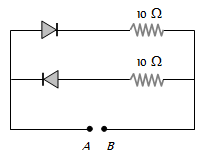
A 2V battery is connected across the points A and B as shown in the figure given below. Assuming that the resistance of each diode is zero in forward bias and infinity in reverse bias, the current supplied by the battery when its positive terminal is connected to A is
The terminal potential difference of a cell when short-circuited is (E = E.M.F. of the cell)
Let $R _1$ be the radius of the second stationary orbit and $R_2$ be the radius of the fourth stationary orbit of an electron in Bohr's model. The ratio $\frac{ R _1}{ R _2}$ is
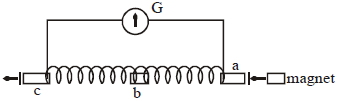
A small bar magnet is moved through a coil at constant speed from one end to the other. Which of the following series of observations wil be seen on the galvanometer $G$ attached across the coil$?$

Three positions shown describe: $(a)$ the magnet's entry $(b)$ magnet is completely inside and $(c)$ magnet's exit.
A simple pendulum of period $T$ has a metal bob which is negatively charged. If it is allowed to oscillate above a positively charged metal plate, its period will
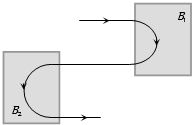
Following figure shows the path of an electron that passes through two regions containing uniform magnetic fields of magnitudes $B_1$ and $B_2$. It's path in each region is a half circle, choose the correct option
Coefficient of mutual inductance between two coils is 2.5 H . If current is changing in one coil at the rate of 1 $A / s$, then magnitude of induced emf in the secondary coil : $\quad \begin{array}{ll} & 0\end{array}$
What happens to the wavelength of a photon after it collides with an electron?
The apparent depth of a needle lying at the bottom of the tank, which is filled with water of refractive index $1.33$ to a height of $12.5\,cm$ is measured by a microscope to be $9.4\,cm$. If water is replaced by a liquid of refractive index $1.5$ upto the same height. What distance would the microscope have to be moved to focus on the needle again ?......$cm$