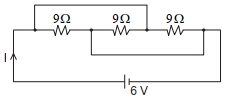
The current $I$ flowing through the given circuit will be $.....A$.
A$8$
B$5$
C$4$
D$2$
JEE MAIN 2022, Medium
Download our app for free and get started
D$2$
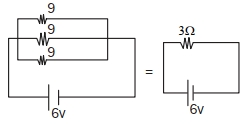
d $I=6 / 3=2\,A$
Download our app
and get started for free
Experience the future of education. Simply download our apps or reach out to us for more information. Let's shape the future of learning together!No signup needed.*
An electric toaster has resistance of $60\ \Omega$ at room temperature $\left(27^{\circ} \mathrm{C}\right)$. The toaster is connected to a $220 \mathrm{~V}$ supply. If the current flowing through it reaches $2.75 \mathrm{~A}$, the temperature attained by toaster is around : (if $\alpha=2 \times 10^{-4} /{ }^{\circ} \mathrm{C}$ )
A horizontal conductor is oriented north south and carries some current. $A$ positively charged particle located vertically above it and having a velocity directed north ward experiences an upward force.What is the direction of the force if this charged particle were located to the east of the conductor and had a velocity directed towards the conductor
In the given figure of meter bridge experiment, the balancing length $AC$ corresponding to null deflection of the galvanometer is $40\,cm$. The balancing length, if the radius of the wire $AB$ is doubled, will be $....cm$
An ammeter $A$ of finite resistance, and a resistor $R$ are joined in series to an ideal cell $C$. $A$ potentiometer $P$ is joined in parallel to $R$. The ammeter reading is $I_0$ and the potentiometer reading is $V_0$. $P$ is now replaced by a voltmeter of finite resistance. The ammeter reading now is $I$ and the voltmeter reading is $V$.
$A$ Wheatstone's bridge is balanced with a resistance of $625\, \Omega$ in the third arm, where $P, Q$ and $S$ are in the $1^{st}, 2^{nd}$ and $4^{th}$ arm respectively. If $P$ and $Q$ are interchanged, the resistance in the third arm has to be increased by $51\,\Omega$ to secure balance. The unknown resistance in the fourth arm is ............. $\Omega$
$A$ battery is of $\mathrm{emf}$ $E$ is being charged from a charger such that positive terminal of the battery is connected to terminal $A$ of charger and negative terminal of the battery is connected to terminal $B$ of charger. The internal resistance of the battery is $r$.
A wheatstone bridge is used to determine the value of unknown resistance $X$ by adjusting the variable resistance $Y$ as shown in the figure. For the most precise measurement of $X$, the resistances $P$ and $Q$: