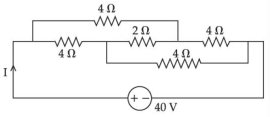
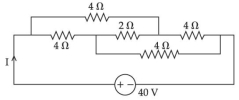
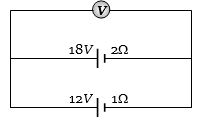
The current $I$ in the given circuit will be $......A$
JEE MAIN 2022, Medium


Download our appand get started for free
Experience the future of education. Simply download our apps or reach out to us for more information. Let's shape the future of learning together!No signup needed.*
Similar Questions
- 1Resistance in the two gaps of a meter bridge are $10\, ohm$ and $30\, ohm$ respectively. If the resistances are interchanged the balance point shifts by.............. $cm$View Solution
- 2Two bulbs of $500\, watt$ and $200\, watt$ are manufactured to operate on $220\, volt$ line. The ratio of heat produced in $500\, W$ and $200\, W$, in two cases, when firstly they are joined in parallel and secondly in series, will beView Solution
- 3The storage battery of a car has an $emf$ of $12\; V$. If the internal resistance of the battery is $0.4\; \Omega,$ what is the maximum current (in $A$) that can be drawn from the battery?View Solution
- 4View SolutionConsider four circuits shown in the figure below. In which circuit power dissipated is greatest (Neglect the internal resistance of the power supply)
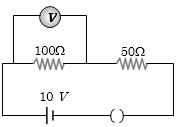
- 5In the given circuit, the voltmeter records $5\, volts$. The resistance of the voltmeter in $ohms$ isView Solution
- 6At room temperature $\left(27^{\circ} \mathrm{C}\right)$, the resistance of a heating element is $50 \Omega$. The temperature coefficient of the material is $2.4 \times 10^{-4}{ }^{\circ} \mathrm{C}^1$. The temperature of the element, when its resistance is $62 \Omega$, is $\qquad$ ${ }^{\circ} \mathrm{C}$.View Solution
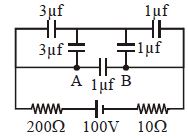
- 7Find potential difference between $A$ and $B$ in given circuit in steady state ............... $\mathrm{V}$View Solution
- 8Two batteries, one of emf $18\,volts\;emf$ and internal resistance $2\,\Omega $ and the other of emf $12\, volt$ and internal resistance $1\,\Omega $, are connected as shown. The voltmeter $V$ will record a reading of .............. $volt$View Solution
- 9If a wire of resistance $20\,\Omega $ is covered with ice and a voltage of $210\, V$ is applied across the wire, then the rate of melting of ice is .................. $g/s$View Solution
- 10$A$ wire of cross-section area $A$, length $L_1$, resistivity $\rho_1$ and temperature coefficient of resistivity $\alpha_1$ is connected to a second wire of length $L_2$, resistivity $\rho_2$ , temperature coefficient of resistivity $\alpha_1$ and the same area $A$, so that wire carries same current. Total resistance $R$ is independent of temperature for small temperature change if (Thermal expansion effect is negligible)View Solution