Resistance in the two gaps of a meter bridge are $10\, ohm$ and $30\, ohm$ respectively. If the resistances are interchanged the balance point shifts by.............. $cm$
Medium


Download our appand get started for free
Experience the future of education. Simply download our apps or reach out to us for more information. Let's shape the future of learning together!No signup needed.*
Similar Questions
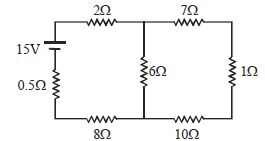
- 1The current from the battery in the given circuit is ................ $A$View Solution
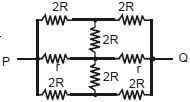
- 2The effective resistance between points $P$ and $Q$ of the electrical circuit shown in the figure isView Solution
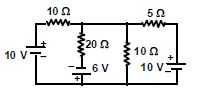
- 3The value of current through the $20\,\Omega $ resistor is ............ $amp$View Solution
- 4Water boils in an electric kettle in $20$ minutes after being switched on. Using the same main supply, the length of the heating element should be. . . . . . .to . . . . . .. times of its initial length if the water is to be boiled in $15$ minutes.View Solution
- 5In $n_e$ and $v_d$ be the number of electrons and drift velocity in a semiconductor. When the temperature is increasedView Solution
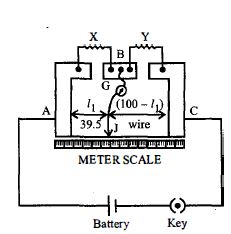
- 6In a meter bridge, as shown in the figure, it is given that resistance $Y=12.5\, \Omega $ and that the balance is obtained at a distance $39.5\, cm$ from end $A$ (by jockey $J$) . After interchanging the resistances $X$ and $Y$, a new balance point is found at a distance $l_2$ from end $A$. What are the values of $X$and $l_2$ ?View Solution
- 7Two wires of same material have length $L$ and $2L $ and cross-sectional areas $4A$ and $A$ respectively. The ratio of their specific resistance would beView Solution
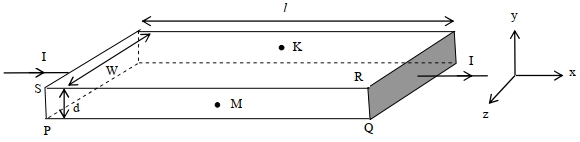
- 8In a thin rectangular metallic strip a constant current $I$ flows along the positive $x$-direction, as shown in the figure. The length, width and thickness of the strip are $\ell$, w and $d$, respectively. A uniform magnetic field $\vec{B}$ is applied on the strip along the positive $y$-direction. Due to this, the charge carriers experience a net deflection along the $z$ direction. This results in accumulation of charge carriers on the surface $P Q R S$ and appearance of equal and opposite charges on the face opposite to $PQRS$. A potential difference along the $z$-direction is thus developed. Charge accumulation continues until the magnetic force is balanced by the electric force. The current is assumed to be uniformly distributed on the cross section of the strip and carried by electrons.View Solution
$1.$ Consider two different metallic strips ($1$ and $2$) of the same material. Their lengths are the same, widths are $w_1$ and $w_2$ and thicknesses are $d_1$ and $d_2$, respectively. Two points $K$ and $M$ are symmetrically located on the opposite faces parallel to the $x$ - $y$ plane (see figure). $V _1$ and $V _2$ are the potential differences between $K$ and $M$ in strips $1$ and $2$ , respectively. Then, for a given current $I$ flowing through them in a given magnetic field strength $B$, the correct statement$(s)$ is(are)
$(A)$ If $w _1= w _2$ and $d _1=2 d _2$, then $V _2=2 V _1$
$(B)$ If $w_1=w_2$ and $d_1=2 d_2$, then $V_2=V_1$
$(C)$ If $w _1=2 w _2$ and $d _1= d _2$, then $V _2=2 V _1$
$(D)$ If $w _1=2 w _2$ and $d _1= d _2$, then $V _2= V _1$
$2.$ Consider two different metallic strips ($1$ and $2$) of same dimensions (lengths $\ell$, width w and thickness $d$ ) with carrier densities $n_1$ and $n_2$, respectively. Strip $1$ is placed in magnetic field $B_1$ and strip $2$ is placed in magnetic field $B_2$, both along positive $y$-directions. Then $V_1$ and $V_2$ are the potential differences developed between $K$ and $M$ in strips $1$ and $2$, respectively. Assuming that the current $I$ is the same for both the strips, the correct option$(s)$ is(are)
$(A)$ If $B_1=B_2$ and $n_1=2 n_2$, then $V_2=2 V_1$
$(B)$ If $B_1=B_2$ and $n_1=2 n_2$, then $V_2=V_1$
$(C)$ If $B _1=2 B _2$ and $n _1= n _2$, then $V _2=0.5 V _1$
$(D)$ If $B_1=2 B_2$ and $n_1=n_2$, then $V_2=V_1$
Give the answer question $1$ and $2.$
- 9The resistance of a wire is $5\,ohm$ at $50\,^o C$ and $6\,ohm $ at $100\,^o C$. The resistance of the wire at $0\,^o C$ will be .............. $\Omega$View Solution
- 10For a metallic wire, the ratio $V/i$ ($V = $ the applied potential difference, $i$ = current flowing) isView Solution