Question
The current in a conductor and the potential difference across its ends are measured by an ammeter and a voltmeter. The meters draw negligible currents. The ammeter is accurate but the voltmeter has a zero error (that is, it does not read zero when no potential difference is applied). Calculate the zero error if the readings for two different conditions are 1.75A, 14.4V and 2.75A, 22.4V.
Answer

Let the voltmeter reading when, the voltage is 0 be X.
$\frac{\text{l}_1\text{R}}{\text{l}_2\text{R}}=\frac{\text{V}_1}{\text{V}_2}$
$\Rightarrow\frac{1.75}{2.75}=\frac{14.4-\text{V}}{22.4-\text{V}}$
$\Rightarrow\frac{0.35}{0.55}=\frac{14.4-\text{V}}{22.4-\text{V}}$
$\Rightarrow\frac{0.07}{0.11}=\frac{14.4-\text{V}}{22.4-\text{V}}$
$\Rightarrow\frac{7}{11}=\frac{14.4-\text{V}}{22.4-\text{V}}$
$\Rightarrow7(22.4-\text{V})=11(14.4-\text{V})$
$\Rightarrow156.8-7\text{V}=158.4-11\text{V}$
$\Rightarrow(7-11)\text{V}=156.8-158.4\Rightarrow-4\text{V}=-1.6$
$\Rightarrow\text{V}=0.4\text{V}.$

Need a full question paper?

Generate a complete, print-ready paper with questions like this in minutes — across 16+ boards, with answer keys.

Start Generating Free

Similar questions

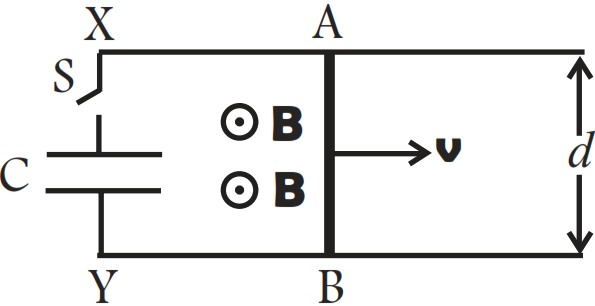
Find the current in the sliding rod AB (resistance = R) for the arrangement shown in Fig. B is constant and is out of the paper. Parallel wires have no resistance. v is constant. Switch S is closed at time t = 0.

Compare and contrast the nature of $\alpha-, \beta-$ and $\gamma-$radiations.
The plates of a capacitor are 2.00cm apart. An electronproton pair is released somewhere in the gap between the plates and it is found that the proton reaches the negative plate at the same time as the electron reaches the positive plate. At what distance from the negative plate was the pair released?
A parallel plate capacitor is to be designed with a voltage rating 1kV, using a material of dielectric constant 3 and dielectric strength about 107Vm–1. (Dielectric strength is the maximum electric field a material can tolerate without breakdown, i.e., without starting to conduct electricity through partial ionisation.) For safety, we should like the field never to exceed, say 10% of the dielectric strength. What minimum area of the plates is required to have a capacitance of 50pF?
A charge Q located at a point $\vec{\text{r}}$ is in equilibrium under the combined electric field of three charges q1, q2, q3. If the charges q1, q2 are located at points $\vec{\text{r}}_1$ and $\vec{\text{r}}_2$ respectively, find the direction of the force on Q, due to q3 in terms of q1, q2$\vec{\text{r}}_1,\ \vec{\text{r}}_2$ and $\vec{\text{r}}.$
A parallel beam of white light is incident normally on a water film 1.0 × 10-4cm thick. Find the wavelength in the visible range (400nm - 700nm) which are strongly transmitted by the film. Refractive index of water = 1.33.
Two metal spheres, one of radius R and the other of radius 2R, both have same surface charge density $\sigma$. They are brought in contact and separated. What will be new surface charge densities on them?
Keeping the source frequency equal to the resonating frequency of the series LCR circuit, if the three elements, L, C and R are arranged in parallel, show that the total current in the parallel LCR circuit is minimum at this frequency. Obtain the current rms value in each branch of the circuit for the elements and source specified in Exercise 7.11 for this frequency.
Obtain an expression for motional electromotive force.
Positive charge Q is distributed uniformly over a circular ring of radius R. A particle having a mass m and a negative charge q, is placed on its axis at a distance x from the centre. Find the force on the particle. Assuming x << R, find the time period of oscillation of the particle if it is released from there.