Question types

Electric Current in Conductors question types

125 questions across 5 question groups — pick any mix to generate a Physics paper with step-by-step answer keys.

125
Questions
5
Question groups
5
Question types
Sample Questions

Electric Current in Conductors questions

One sample from each question group in this chapter. Select any group above to see the full set with answer keys.

A current passes through a wire of non-uniform cross-section. Which of the following quantities are independent of the cross-section?
  1. The charge crossing in a given time interval.
  2. Drift speed.
  3. Current density.
  4. Free-electron density.
View full solution
Two non-ideal batteries are connected in parallel. Consider the following statements:
  1. The equivalent emf is smaller than either of the two emfs.
  2. The equivalent internal resistance is smaller than either of the two internal resistances.
  1. Both A and B are correct.
  2. A is correct but B is wrong.
  3. B is correct but A is wrong.
  4. Both A and B are wrong.
View full solution
Identify the correct options:
  1. An ammeter should have small resistance.
  2. An ammeter should have large resistance.
  3. A voltmeter should have small resistance.
  4. A voltmeter should have large resistance.
View full solution
When no current is passed through a conductor:
  1. The free electrons do not move.
  2. The average speed of a free electron over a large period of time is zero.
  3. The average velocity of a free electron over a large period of time is zero.
  4. The average of the velocities of all the free electrons at an instant is zero.
View full solution
A capacitor with no dielectric is connected to a battery at t = 0. Consider a point A in the connecting wires and a point B in between the plates.
  1. There is no current through A.
  2. There is no current through B.
  3. There is a current through A as long as the charging is not complete.
  4. There is a current through B as long as the charging is not complete.
View full solution
The thermal energy developed in a current-carrying resistor is given by U = i2 Rt and also by U = Vit. Should we say that U is proportional to i2 or i?
View full solution
One of your friends argues that he has read in the previous chapters that there can be no electric field inside a conductor. And hence there can be no current through it. What is the fallacy of this argument?
View full solution
The drift speed is defined as $\text{v}_\text{d}=\frac{\Delta\text{l}}{\Delta\text{t}}$ where $\Delta\text{l}$ is the distance drifted in a long time $\Delta\text{t}.$ Why don't we define the drift speed as the limit of $\frac{\Delta\text{l}}{\Delta\text{t}}\ \text{as}\ \Delta\text{t}\rightarrow0?$
View full solution
Consider a circuit containing an ideal battery connected to a resistor. Do "work done by the battery" and "the thermal energy developed" represent two names of the same physical quantity?
View full solution
A non-ideal battery is connected to a resistor. Is work done by the battery equal to the thermal energy developed in the resistor? Will your answer change if the battery is ideal?
View full solution
In an electrolyte, the positive ions move from left to right and the negative ions from right to left. Is there a net current? If yes, in what direction?
View full solution
Q 173 Marks Question3 Marks
A capacitor of capacitance $10\mu\text{F}$ is connected across a battery of emf 6.0V through a resistance of $20\text{k}\Omega$ for 4.0s. The battery is then replaced by a thick wire. What will be the charge on the capacitor 4.0s after the battery is disconnected?
View full solution
Q 203 Marks Question3 Marks
The potential difference between the terminals of a battery of emf 6.0V and internal resistance $1\Omega$ drops to 5.8V when connected across an external resistor. Find the resistance of the external resistor.
View full solution
A copper wire of radius 0.1mm and resistance $1\text{k}\Omega$ is connected across a power supply of 20V.
(a) How many electrons are transferred per second between the supply and the wire at one end? (b) Write down the current density in the wire.
View full solution
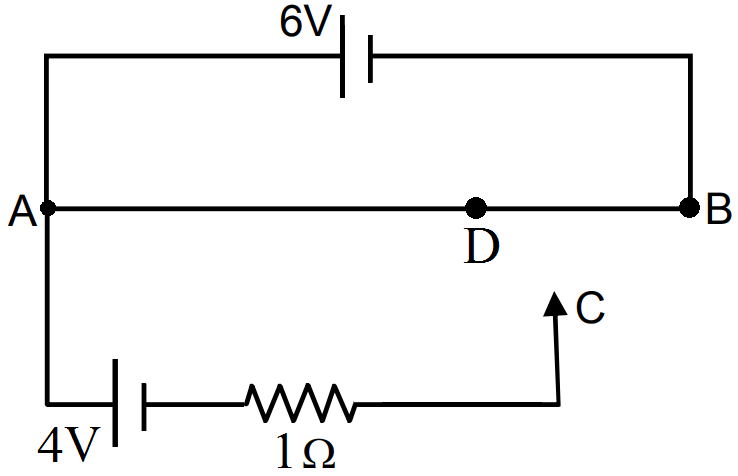
A 6 volt battery of negligible internal resistance is connected across a uniform wire AB of length 100cm. The positive terminal of another battery of emf 4V and internal resistance $1\Omega$ is joined to the point A, as shown in the figure. Take the potential at B to be zero. (a) What are the potentials at the points A and C? (b) At which point D of the wire AB, the potential is equal to the potential at C? (c) If the points C and D are connected by a wire, what will be the current through it? (d) If the 4V battery is replaced by a 7.5V battery, what would be the answers of parts (a) and (b)?

View full solution
A capacitor of capacitance $12.0\mu\text{F}$ is connected to a battery of emf 6.00V and internal resistance $1.00\Omega$ through resistanceless leads. $12.0\mu\text{s}$ after the connections are made, what will be (a) the current in the circuit (b) the power delivered by the battery (c) the power dissipated in heat and (d) the rate at which the energy stored in the capacitor is increasing.
View full solution
The plates of a capacitor of capacitance $10\mu\text{F},$ charged to $60\mu\text{C},$ are joined together by a wire of resistance $10\Omega$ at t = 0. Find the charge on the capacitor in the circuit at (a) t = 0 (b) $\text{t}=30\mu\text{s}$ (c) $\text{t}=120\mu\text{s}$ and (d) t = 1.0ms.
View full solution

Generate a Electric Current in Conductors paper free

Pick question groups from the list above, set marks and difficulty, and export a branded PDF with step-by-step answer keys. First 3 chapters free — no signup.

Download App