MCQ
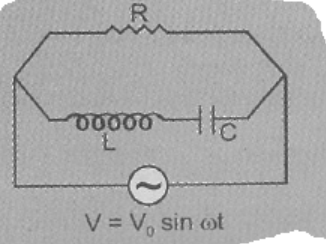
The Current in resistance R at resonance is.
- AZero
- BMinimum but finite
- CMaximum but finite
- DInfinite
Explanation:
At resonance XL = XC
⇒ R & current is maximum but finite, which is
$\text{I}_\text{max}=\frac{\text{E}}{\text{R}}$ where E is applied voltag.
Generate a complete, print-ready paper with questions like this in minutes — across 16+ boards, with answer keys.
In the circuit shown below, The reading of the voltmeter V is

|
(a) 12 V |
(b) 8 V |
(c) 20 V |
(d) 16 V |
A bar magnet is placed north-south with its north pole due north. The points of zero magnetic field will be in which direction from the centre of the magnet
| (a) North and south | (b) East and west |
| (c) North-east and south-west | (d) North-west and south-east |
If the cathode–anode potential difference in an X-ray tube be 105 V, then the maximum energy of X-ray photon can be
| (a) 105 J | (b) 105 MeV | (c) 10–1 MeV | (d) 105 KeV |
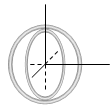
Two insulated rings, one of slightly smaller diameter than the other are suspended along their common diameter as shown. Initially the planes of the rings are mutually perpendicular. When a steady current is set up in each of them
|
(a) The two rings rotate into a common plane |
|
(b) The inner ring oscillates about its initial position |
|
(c) The inner ring stays stationary while the outer one moves into the plane of the inner ring |
|
(d) The outer ring stays stationary while the inner one moves into the plane of the outer ring |
All of the following statements are true except
|
(a) Conductance is the reciprocal of resistance and is measured in Siemens |
|
(b) Ohm's law is not applicable at very low and very high temperatures |
|
(c) Ohm's law is applicable to semiconductors |
|
(d) Ohm's law is not applicable to electron tubes, discharge tubes and electrolytes |
A constant voltage is applied between the two ends of a metallic wire. If both the length and the radius of the wire are doubled, the rate of heat developed in the wire
|
(a) Will be doubled |
(b) Will be halved |
|
(c) Will remain the same |
(d) Will be quadrupled |
A deutron is bombarded on  nucleus and a-particle is emitted. The product nucleus is
|
(a) |
(b) |
(c) |
(d) |


