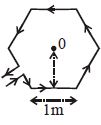
The current of $1\,A$ is passed through a hexagonal conducting wire of side $1\,m$ . The magnetic induction at its centre $O$ in $Wb/m^2$ will be
Medium


Download our appand get started for free
Experience the future of education. Simply download our apps or reach out to us for more information. Let's shape the future of learning together!No signup needed.*
Similar Questions
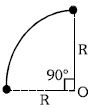
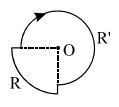
- 1A wire of magnetic moment $M$ is moulded according to figure, then magnetic moment becomesView Solution
- 2A proton (mass $m$ and charge $+e$) and an $\alpha - $particle (mass $4m$ and charge $+2e$) are projected with the same kinetic energy at right angles to the uniform magnetic field. Which one of the following statements will be trueView Solution
- 3A winding wire which is used to frame a solenoid can bear a maximum $10\, A$ current. If length of solenoid is $80\,cm$ and it's cross sectional radius is $3\, cm$ then required length of winding wire is $(B = 0.2\,T)$View Solution
- 4View SolutionElectrons moving with different speeds enter a uniform magnetic field in a direction perpendicular to the field., time periods of rotation will be :
- 5The magnetic force acting on charged particle of charge $2\,\mu C$ in magnetic field of $2\, T$ acting in $y-$ direction , when the particle velocity is $\left( {2\hat i + 3\hat j} \right) \times {10^6}\,m{s^{ - 1}}$ isView Solution
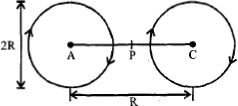
- 6A Helmholtz coil has pair of loops, each with $N$ turns and radius $R$. They are placed coaxially at distance $R$ and the same current $I$ flows through the loops in the same direction. The magnitude of magnetic field at $P$, midway between the centres $A$ and $C$, is given by (Refer to figure)View Solution
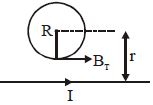
- 7In following diagram there is a straight wire carrying a current $I.$ Consider a circular path with radius $(R)$ near it. It $\vec B_T$ is the tangential component of magnetic field then find the value of integral $\int {{{\vec B}_T}.\overrightarrow {dl} } $View Solution
- 8A rectangular coil of length $0 .12\, m$ and width $0.1\, m$ having $50$ turns of wire is suspended vertically in a uniform magnetic field of strength $0.2\,\, Weber/m^2.$ The coil carries a current of $2 \,\,A.$ If the plane of the coil is inclined at an angle of $30^o $ with the direction of the field, the torque required to keep the coil in stable equilibrium will be .......$Nm$View Solution
- 9A current of $i$ ampere is flowing through each of the bent wires as shown the magnitude and direction of magnetic field at $O$ isView Solution
- 10View SolutionAssertion : A charge, whether stationary or in motion produces a magnetic field around it.
Reason : Moving charges produce only electric field in the surrounding space.