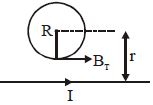
In following diagram there is a straight wire carrying a current $I.$ Consider a circular path with radius $(R)$ near it. It $\vec B_T$ is the tangential component of magnetic field then find the value of integral $\int {{{\vec B}_T}.\overrightarrow {dl} } $
Medium


Download our appand get started for free
Experience the future of education. Simply download our apps or reach out to us for more information. Let's shape the future of learning together!No signup needed.*
Similar Questions
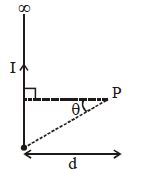
- 1Magnetic field due to semi infinite length wire at point $P$View Solution
- 2An electron (mass $= 9 \times 10^{-31}\,kg$. Charge $= 1.6 \times 10^{-19}\,C$) whose kinetic energy is $7.2 \times 10^{-18}$ $joule$ is moving in a circular orbit in a magnetic field of $9 \times 10^{-5} \,weber/m^2$. The radius of the orbit is.....$cm$View Solution
- 3A current carrying wire of length $L$ is transformed into a coil of $N$ turns. To achieve maximum magnetic moment, the coilView Solution
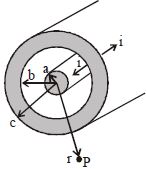
- 4A coaxial cable having radii $a, b$ and $c$ carries equal and opposite currents of magnitude $i$ the inner and outer conductors. What is the magnitude of the magnetic induction at point $P$ outside of the cable at a distance $r$ from the axis?View Solution
- 5A cell of emf $90\,V$ is connected across series combination of two resistors each of $100\,\Omega$ resistance. A voltmeter of resistance $400\,\Omega$ is used to measure the potential difference across each resistor. The reading of the voltmeter will be $.........\,V$View Solution
- 6View SolutionA negatively charged particle projected towards east is deflected towards north by a magnetic field. The field may be
- 7A thin wire of length $l$ is carrying a constant current. The wire is bent to form a circular coil. If radius of the coil, thus formed, is equal to $R$ and number of turns in it is equal to $n$, then which of the following graphs represent $(s)$ variation of magnetic field induction $(b)$ at centre of the coilView Solution
- 8An ammeter whose resistance is $180\,\Omega $ gives full scale deflection when current is $2\, mA$. The shunt required to convert it into an ammeter reading $20\, mA$ (in $ohms$) isView Solution
- 9$20$ $ampere$ current is flowing in a long straight wire. The intensity of magnetic field at a distance $20\, cm$ from the wire will beView Solution
- 10Two particles $A$ and $B$ of masses ${m_A}$ and ${m_B}$ respectively and having the same charge are moving in a plane. A uniform magnetic field exists perpendicular to this plane. The speeds of the particles are ${v_A}$ and ${v_B}$ respectively, and the trajectories are as shown in the figure. ThenView Solution