The current of $5 \mathrm{~A}$ flows in a square loop of sides $1$ $\mathrm{m}$ is placed in air. The magnetic field at the centre of the loop is $\mathrm{X} \sqrt{2} \times 10^{-7} \mathrm{~T}$. The value of $\mathrm{X}$ is____.
JEE MAIN 2024, Diffcult
Download our app for free and get started
$B=4 \times \frac{\mu_0 i}{4 \pi(1 / 2)}\left(\frac{1}{\sqrt{2}}+\frac{1}{\sqrt{2}}\right)$
$=4 \times 10^{-7} \times 5 \times 2 \times \sqrt{2}$
$=40 \sqrt{2} \times 10^{-7} \mathrm{~T}$

Download our appand get started for free
Experience the future of education. Simply download our apps or reach out to us for more information. Let's shape the future of learning together!No signup needed.*
Similar Questions
- 1A proton and an electron both moving with the same velocity $v$ enter into a region of magnetic field directed perpendicular to the velocity of the particles. They will now move in circular orbits such thatView Solution
- 2Under the influence of a uniform magnetic field a charged particle is moving in a circle of radius $R$ with constant speed $v$. The time period of the motionView Solution
- 3The region between $y = 0$ and $y = d$ contains a magnetic field $\vec B = B\hat z$ A particle of mass $m$ and charge $q$ enters the region with a velocity $\vec v = v\hat i$. If $d = \frac{{mv}}{{2qB}}$ , the acceleration of the charged particle at the point of its emergence at the other side isView Solution
- 4A proton, a deuteron and an $\alpha-$particle with same kinetic energy enter into a uniform magnetic field at right angle to magnetic field. The ratio of the radii of their respective circular paths isView Solution
- 5A long straight wire with a circular crosssection having radius $R$, is carrying a steady current $I$. The current I is uniformly distributed across this cross-section. Then the variation of magnetic field due to current I with distance $r\;( r < R )$ from its centre will beView Solution
- 6Electron of mass $m$ and charge $q$ is travelling with a speed along a circular path of radius $r$ at right angles to a uniform magnetic field of intensity $B$. If the speed of the electron is doubled and the magnetic field is halved the resulting path would have a radiusView Solution
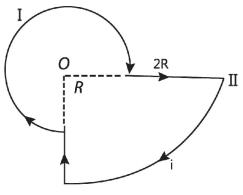
- 7Consider the circular loop having current $i$ and with central point $O$. The magnetic field at the central point $O$ isView Solution
- 8Two particles $A$ and $B$ having equal charges $+6\,C$, after being accelerated through the same potential difference, enter in a region of uniform magnetic field and describe circular paths of radii $2\,cm$ and $3\,cm$ respectively. The ratio of mass of $A$ to that of $B$ isView Solution
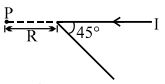
- 9A long straight wire, carrying current $I,$ is bent at its midpoint to from an angle of $45^o.$ Induction of magnetic field at point $P,$ distant $R$ from point of bending is equal to :View Solution
- 10If the strength of the magnetic field produced $10\,cm$ away from a infinitely long straight conductor is ${10^{ - 5}}\,Weber/{m^2}$, the value of the current flowing in the conductor will be........$ampere$View Solution