A proton and an electron both moving with the same velocity $v$ enter into a region of magnetic field directed perpendicular to the velocity of the particles. They will now move in circular orbits such that
Easy


Download our appand get started for free
Experience the future of education. Simply download our apps or reach out to us for more information. Let's shape the future of learning together!No signup needed.*
Similar Questions
- 1A proton moving with a velocity, $2.5 \times {10^7}\,m/s$, enters a magnetic field of intensity $2.5\,T$ making an angle ${30^o}$ with the magnetic field. The force on the proton isView Solution
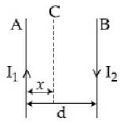
- 2Two wires $A$ and $B$ are carrying currents $I_1$ and $I_2$ as shown in the figure. The separation between them is $d$. A third wire $C$ carrying a current $I$ is to be kept parallel to them at a distance $x$ from $A$ such that the net force acting on it is zero. The possible values of $x$ areView Solution
- 3Force on current carrying loop (Radius $= R$ ) in uniform magnetic $(B)$ field which is at an angle $30^{\circ}$ with the normal will beView Solution
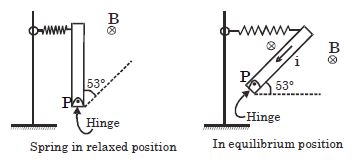
- 4A thin uniform rod with negligible mass and length $l$ is attached to the floor by a frictionless hinge at point $P$ . A horizontal spring with force constant $k$ connects the other end to wall. The rod is in a uniform magnetic field $B$ directed into the plane of paper. What is extension in spring in equilibrium when a current $i$ is passed through the rod in direction shown. Assuming spring to be in natural length initially.View Solution
- 5Two particles $A$ and $B$ having equal charges $+6\,C$, after being accelerated through the same potential difference, enter in a region of uniform magnetic field and describe circular paths of radii $2\,cm$ and $3\,cm$ respectively. The ratio of mass of $A$ to that of $B$ isView Solution
- 6View SolutionA charged particle enters a uniform magnetic field perpendicular to it. The magnetic field
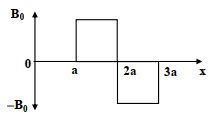
- 7A magnetic field $\overrightarrow{\mathrm{B}}=\mathrm{B}_0 \hat{\mathrm{j}}$ exists in the region $\mathrm{a} < \mathrm{x} < 2 \mathrm{a}$ and $\vec{B}=-B_0 \hat{j}$, in the region $2 \mathrm{a} < \mathrm{x} < 3 \mathrm{a}$, where $\mathrm{B}_0$ is a positive constant. $\mathrm{A}$ positive point charge moving with a velocity $\overrightarrow{\mathrm{v}}=\mathrm{v}_0 \hat{\dot{i}}$, where $v_0$ is a positive constant, enters the magnetic field at $x=a$. The trajectory of the charge in this region can be like,View Solution
- 8Two charges of same magnitude move in two circles of radii $R_1=R$ and $R_2=2 R$ in a region of constant uniform magnetic field $B _0$. The work $W_1$ and $W_2$ done by the magnetic field in the two cases respectively, are such thatView Solution
- 9If only $2\,%$ of the main current is to be passed through a galvanometer of resistance $G$, then the resistance of shunt will beView Solution
- 10View SolutionA current carrying coil is subjected to a uniform magnetic field. The coil will orient so that its plane becomes