MCQ
The current through choke coil increases form zero to $6 A$ in $0.3$ seconds and an induced e.m.f. of $30 \mathrm{~V}$ is produced. The inductance of the coil of choke is
  • A
    $5 \mathrm{H}$
  • B
    $2.5 \mathrm{H}$
  • $1.5 \mathrm{H}$
  • D
    $2 \mathrm{H}$

Answer

Correct option: C.
$1.5 \mathrm{H}$
(c) $|e|=L \frac{d i}{d t} \Rightarrow 30=L \times \frac{(6-0)}{0.3} \Rightarrow L=1.5 \mathrm{H}$

Need a full question paper?

Generate a complete, print-ready paper with questions like this in minutes — across 16+ boards, with answer keys.
Start Generating Free

Similar questions

A particle moves with constant speed $v$ along a circular path of radius $r$ and completes the circle in time $T$. The acceleration of the particle is
Velocity of light in a medium is $1.5 \times 10^8 \mathrm{~m} / \mathrm{s}$. Its refractive index will be
Which of the following graphs correctly represents the variation of $\beta=-(d V / d P) / V$ with $P$ for an ideal gas at constant temperature
Water rises in a vertical capillary tube upto a height of $2.0 \mathrm{~cm}$. If the tube is inclined at an angle of $60^{\circ}$ with the vertical, then upto what length the water will rise in the tube
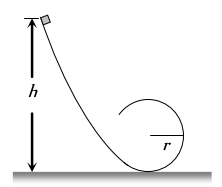
A block follows the path as shown in the figure from height $h$. If radius of circular path is $r$, then relation that holds good to complete full circle is

Image

Two tuning forks $A$ and $B$ give 4 beats per second. The frequency of $A$ is $256 \mathrm{~Hz}$. On loading $B$ slightly, we get 5 beats in 2 seconds. The frequency of $B$ after loading is
The resistivity of alloys $=R_{\text {alloy }}$; the resistivity of constituent metals $R_{\text {metal }}$. Then, usually
A bullet of mass $5 g$ is shot from a gun of mass $5 kg$. The muzzle velocity of the bullet is $500 m / s$. The recoil velocity of the gun is
The ratio of thickness of plates of two transparent mediums $A$ and $B$ is $6: 4$. If light takes equal time in passing through them, then refractive index of $B$ with respect to $A$ will be
A simple telescope, consisting of an objective of focal length $60 \mathrm{~cm}$ and a single eye lens of focal length $5 \mathrm{~cm}$ is focussed on a distant object is such a way that parallel rays comes out from the eye lens. If the object subtends an angle $2$ at the objective, the angular width of the image