MCQ 11 Mark
A coil of $N=100$ turns carries a current $l=5 \mathrm{~A}$ and creates a magnetic flux $\phi=10^{-5} \mathrm{Tm}^{-2}$ per turn. The value of its inductance $L$ will be
- A
$0.05 \mathrm{mH}$
- B
$0.10 \mathrm{mH}$
- C
$0.15 \mathrm{mH}$
- ✓
$0.20 \mathrm{mH}$
AnswerCorrect option: D. $0.20 \mathrm{mH}$
(d) $N \phi=L i \Rightarrow 100 \times 10^{-5}=L \times 5 \Rightarrow L=0.2 \mathrm{mH}$.
View full question & answer→MCQ 21 Mark
A circular metal plate of radius $R$ is rotating with a uniform angular velocity $\omega$ with its plane perpendicular to a uniform magnetic field $B$. Then the emf developed between the centre and the rim of the plate is
- A
$\pi \omega B R^2$
- B
$\omega B R^2$
- C
$\pi \omega B R^2 / 2$
- ✓
$\omega B R^2 / 2$
AnswerCorrect option: D. $\omega B R^2 / 2$
View full question & answer→MCQ 31 Mark
A motor having an armature of resistance $2 \Omega$ is designed to operate at $220 V$ mains. At full speed, it develops a back e.m.f. of $210 \mathrm{~V}$. When the motor is running at full speed, the current in the armature is
- ✓
$5\ A$
- B
$105\ A$
- C
$110 \mathrm{~A}$
- D
$215\ A$
AnswerCorrect option: A. $5\ A$
$ i=\frac{E-e}{R}=\frac{220-210}{2}=\frac{10}{2}=5 \mathrm{~A}$
View full question & answer→MCQ 41 Mark
When the current through a solenoid increases at a constant rate, the induced current
- A
Is constant and is in the direction of the inducing current
- ✓
Is a constant and is opposite to the direction of the inducing current
- C
Increases with time and is in the direction of the inducing current
- D
Increases with time and opposite to the direction of the inducing current
AnswerCorrect option: B. Is a constant and is opposite to the direction of the inducing current
(b) According to Lenz's law.
View full question & answer→MCQ 51 Mark
A magnet is brought towards a coil (i) speedly (ii) slowly then the induced e.m.f./induced charge will be respectively
- A
More in first case / More in first case
- ✓
More in first case/Equal in both case
- C
Less in first case/More in second case
- D
Less in first case/Equal in both case
AnswerCorrect option: B. More in first case/Equal in both case
The magnitude of induced e.m.f. is directly proportional to the rate of change of magnetic flux. Induced charge doesn't depend upon time.
View full question & answer→MCQ 61 Mark
A conducting wire is dropped along east-west direction, then
- A
- B
- ✓
Induced current flows from west to east
- D
Induced current flows from east to west
AnswerCorrect option: C. Induced current flows from west to east
View full question & answer→MCQ 71 Mark
Work of electric motor is
- A
- B
- C
Both $(a)$ and $(b)$
- ✓
To convert ac into mechanical work
AnswerCorrect option: D. To convert ac into mechanical work
To convert ac into mechanical work
View full question & answer→MCQ 81 Mark
In a dc motor, induced e.m.f. will be maximum
- ✓
When motor takes maximum speed
- B
When motor starts rotating
- C
When speed of motor increases
- D
When motor is switched off
AnswerCorrect option: A. When motor takes maximum speed
Back emf $\propto$ speed of motor.
View full question & answer→MCQ 91 Mark
In an induction coil with resistance, the induced emf will be maximum when
- A
The switch is put on due to high resistance
- ✓
The switch is put off due to high resistance
- C
The switch is put on due to low resistance
- D
The switch is put off due to low resistance
AnswerCorrect option: B. The switch is put off due to high resistance
View full question & answer→MCQ 101 Mark
In a primary coil $5 \mathrm{~A}$ current is flowing on $220$ volts. In the secondary coil $2200 \mathrm{~V}$ voltage produces. Then ratio of number of turns in secondary coil and primary coil will be
- A
$1: 10$
- ✓
$10: 1$
- C
$1: 1$
- D
$11: 1$
AnswerCorrect option: B. $10: 1$
(b) $\frac{N_s}{N_p}=\frac{V_s}{V_p}=\frac{2200}{220}=\frac{10}{1}$
View full question & answer→MCQ 111 Mark
A capacitor is fully charged with a battery. Then the battery is removed and coil is connected with the capacitor in parallel, current varies as
MCQ 121 Mark
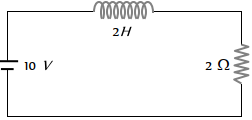
In the figure magnetic energy stored in the coil is
MCQ 131 Mark
If in a coil rate of change of area is $5 \mathrm{~m} / \mathrm{milli}$ second and current become $1$ amp from $2$ amp in $2 \times 10^{-3} \mathrm{sec}$. If magnitude of field is 1 tesla then self inductance of the coil is
- A
$2 \mathrm{H}$
- B
$5 \mathrm{H}$
- C
$20 \mathrm{H}$
- ✓
$10 \mathrm{H}$
AnswerCorrect option: D. $10 \mathrm{H}$
$ N \phi=L i \Rightarrow \frac{N d \phi}{d t}=\frac{L d i}{d t} \Rightarrow N B \frac{d A}{d t}=\frac{L d i}{d t} $
$ \Rightarrow \frac{1 \times 1 \times 5}{10^{-3}}=L \times\left(\frac{2-1}{2 \times 10^{-3}}\right) \Rightarrow L=10 H$
View full question & answer→MCQ 141 Mark
A transformer has turn ratio $100/1.$ If secondary coil has 4 amp current then current in primary coil is
- A
$4 \mathrm{~A}$
- ✓
$0.04 \mathrm{~A}$
- C
$0.4 \mathrm{~A}$
- D
$400 \mathrm{~A}$
AnswerCorrect option: B. $0.04 \mathrm{~A}$
(b) $\frac{i_p}{i_s}=\frac{N_s}{N_p} \Rightarrow \frac{i_p}{4}=\frac{1}{100} \Rightarrow i_p=0.04 \mathrm{~A}$
View full question & answer→MCQ 151 Mark
The number of turns in primary and secondary coils of a transformer are 100 and 20 respectively. If an alternating potential of 200 volt is applied to the primary, the induced potential in secondary will be
- A
(a) $10 \mathrm{~V}$
- ✓
(b) $40 \mathrm{~V}$
- C
(c) $1000 \mathrm{~V}$
- D
(d) $20,000 \mathrm{~V}$
AnswerCorrect option: B. (b) $40 \mathrm{~V}$
(b) $\frac{N_s}{N_p}=\frac{V_s}{V_p}=\frac{2200}{220}=\frac{10}{1}$
View full question & answer→MCQ 161 Mark
A coil of $40 \Omega$ resistance has $100$ turns and radius $6 \mathrm{~mm}$ is connected to ammeter of resistance of $160$ ohms. Coil is placed perpendicular to the magnetic field. When coil is taken out of the field, $32\ \mu \mathrm{C}$ charge flows through it. The intensity of magnetic field will be
- A
$6.55 T$
- B
$5.66 T$
- C
$0.655 T$
- ✓
$0.566 T$
AnswerCorrect option: D. $0.566 T$
$ q=-\frac{N}{R}\left(B_2-B_1\right) A \cos \theta $
$ 32 \times 10^{-6}=-\frac{100}{(160+40)}(0-B) \times \pi \times\left(6 \times 10^{-3}\right)^2 \times \cos 0^{\circ} $
$ \Rightarrow B=0.565\ T$
View full question & answer→MCQ 171 Mark
The mutual inductance of an induction coil is $5 \mathrm{H}$. In the primary coil, the current reduces from $5 \mathrm{~A}$ to zero in $10^{-3} \mathrm{~s}$. What is the induced emf in the secondary coil
- A
$2500 \mathrm{~V}$
- ✓
$25000 \mathrm{~V}$
- C
$2510 \mathrm{~V}$
- D
$0$
AnswerCorrect option: B. $25000 \mathrm{~V}$
(b) $e=-M \frac{d i}{d t}=-5 \times \frac{(-5)}{10^{-3}}=25000 \mathrm{~V}$
View full question & answer→MCQ 181 Mark
The inductance of a closed-packed coil of 400 turns is $8 \mathrm{mH}$. A current of $5 \mathrm{~mA}$ is passed through it. The magnetic flux through each turn of the coil is
- ✓
$\frac{1}{4 \pi} \mu_0 W b$
- B
$\frac{1}{2 \pi} \mu w b$
- C
$\frac{1}{3 \pi} \mu_0 W b$
- D
$0.4 \mu_0 \mathrm{~Wb}$
AnswerCorrect option: A. $\frac{1}{4 \pi} \mu_0 W b$
(a) $N \phi=L i \Rightarrow \phi=\frac{L i}{N}=\frac{8 \times 10^{-3} \times 5 \times 10^{-3}}{400}=10^{-7}=\frac{\mu_0}{4 \pi} w b$
View full question & answer→MCQ 191 Mark
The current in a $L R$ circuit builds up to $\frac{3}{4} t h$ of its steady state value in $4 s$. The time constant of this circuit is
- A
$\frac{1}{\ln 2} s$
- ✓
$\frac{2}{\ln 2} s$
- C
$\frac{3}{\ln 2} s$
- D
$\frac{4}{\ln 2} s$
AnswerCorrect option: B. $\frac{2}{\ln 2} s$
(b) We know that $i=i_o\left[1-e^{\frac{-R t}{L}}\right]$ or $\frac{3}{4} i_o=i_o\left[1-e^{-t / \tau}\right]$ (where $\tau=\frac{L}{R}=$ time constant)
$ \frac{3}{4}=1-e^{-t / \tau} \text { or } e^{-t / \tau}=1-\frac{3}{4}=\frac{1}{4} $
$ e^{t / \tau}=4 \text { or } \frac{t}{\tau}=\ln 4 $
$ \Rightarrow \tau=\frac{t}{\ln 4}=\frac{4}{2 \ln 2} \Rightarrow \tau=\frac{2}{\ln 2} \mathrm{sec} .$
View full question & answer→MCQ 201 Mark
A wire of length $1 \mathrm{~m}$ is moving at a speed of $2 \mathrm{~ms}$ perpendicular to its length and a homogeneous magnetic field of $0.5 T$. The ends of the wire are joined to a circuit of resistance $6 \Omega$. The rate at which work is being done to keep the wire moving at constant speed is
- A
$\frac{1}{12} W$
- ✓
$\frac{1}{6} W$
- C
$\frac{1}{3} W$
- D
$1 W$
AnswerCorrect option: B. $\frac{1}{6} W$
(b) Rate of work $=\frac{W}{t}=P=F v$; also $F=B i l=B\left(\frac{B v l}{R}\right) l$
$\Rightarrow P=\frac{B^2 v^2 l^2}{R}=\frac{(0.5)^2 \times(2)^2 \times(1)^2}{6}=\frac{1}{6} W$
View full question & answer→MCQ 211 Mark
The magnetic flux linked with coil, in weber is given by the equation, $\phi=5 t^2+3 t+16$. The induced emf in the coil in the fourth second is
- ✓
$10 \mathrm{~V}$
- B
$30 \mathrm{~V}$
- C
$45 \mathrm{~V}$
- D
$90 \mathrm{~V}$
AnswerCorrect option: A. $10 \mathrm{~V}$
(a)$|e|=\frac{d \phi}{d t}=\frac{d}{d t}\left(5 t^2+3 t+16\right)=(10 t+3)$
when $t=3 \mathrm{sec}, e_3=(10 \times 3+3)=33 \mathrm{~V}$
when $t=4 \mathrm{sec}, e_4=(10 \times 4+3)=43 \mathrm{~V}$
Hence emf induced in fourth second$=e_4-e_3=43-33=10 \mathrm{~V}$
View full question & answer→MCQ 221 Mark
If a copper ring is moved quickly towards south pole of a powerful stationary bar magnet, then
- ✓
Current flows through the copper ring
- B
Voltage in the magnet increase
- C
Current flows in the magnet
- D
Copper ring will get magnetised
AnswerCorrect option: A. Current flows through the copper ring
Magnetic flux linked with the ring changes so current flows through it.
View full question & answer→MCQ 231 Mark
A circular coil of mean radius of $7 \mathrm{~cm}$ and having $4000$ turns is rotated at the rate of $1800$ revolutions per minute in the earth's magnetic field ( $B=0.5$ gauss), the maximum e.m.f. induced in coil will be
- A
$1.158 \mathrm{~V}$
- ✓
$0.58 \mathrm{~V}$
- C
$0.29 \mathrm{~V}$
- D
$5.8 \mathrm{~V}$
AnswerCorrect option: B. $0.58 \mathrm{~V}$
$e_0=\omega N B A=(2 \pi v) N B\left(\pi r^2\right)=2 \times \pi^2 v N B r^2 $
$ =2 \times(3.14)^2 \times \frac{1800}{60} \times 4000 \times 0.5 \times 10^{-4} \times\left(7 \times 10^{-2}\right)^2 $
$ =0.58 \mathrm{~V}$
View full question & answer→MCQ 241 Mark
If the current $30 \mathrm{~A}$ flowing in the primary coil is made zero in $0.1$ sec. The emf induced in the secondary coil is $1.5$ volt. The mutual inductance between the coil is
- A
$0.05 \mathrm{H}$
- B
$1.05 \mathrm{H}$
- C
$0.1 \mathrm{H}$
- ✓
$0.2 \mathrm{H}$
AnswerCorrect option: D. $0.2 \mathrm{H}$
View full question & answer→MCQ 251 Mark
A coil of resistance $10 \Omega$ and an inductance $5 H$ is connected to a 100 volt battery. Then energy stored in the coil is
- A
$125 \mathrm{~erg}$
- B
$125 \mathrm{~J}$
- C
$250 \mathrm{~erg}$
- ✓
$250 \mathrm{~J}$
AnswerCorrect option: D. $250 \mathrm{~J}$
(d) $U=\frac{1}{2} L i^2 \Rightarrow U=\frac{1}{2} \times 5 \times\left(\frac{100}{10}\right)^2=250 \mathrm{~J}$
View full question & answer→MCQ 261 Mark
The output voltage of a transformer connected to $220$ volt line is $1100$ volt at $1$ amp current. Its efficiency is $100 \%$. The current coming from the line is
- A
$20 \mathrm{~A}$
- ✓
$10 \mathrm{~A}$
- C
$11 \mathrm{~A}$
- D
$22 \mathrm{~A}$
AnswerCorrect option: B. $10 \mathrm{~A}$
(b) For $100 \%$ efficiency $V_s i_s=V_p i_p$
$\Rightarrow 1100 \times 2=220 \times i_p \Rightarrow i_p=10 \mathrm{~A}$
View full question & answer→MCQ 271 Mark
The coil of area $0.1 \mathrm{~m}$ has 500 turns. After placing the coil in a magnetic field of strength $4 \times 10^{-4} \mathrm{~Wb} / \mathrm{m}^2$, if rotated through 90 in $0.1 \mathrm{~s}$, the average $\mathrm{emf}$ induced in the coil is
- A
(a) $0.012 \mathrm{~V}$
- B
(b) $0.05 \mathrm{~V}$
- C
(c) $0.1 \mathrm{~V}$
- D
(d) $0.2 \mathrm{~V}$
Answer& =-\frac{500 \times 4 \times 10^{-4} \times 0.1(\cos 90-\cos 0)}{0.1}=0.2 \mathrm{~V}\end{aligned}$(d)$\begin{aligned}& e=\frac{-N B A\left(\cos \theta_2-\cos \theta_1\right)}{\Delta t} \\
View full question & answer→MCQ 281 Mark
A step up transformer has transformation ration $5: 3$. What is voltage in secondary if voltage in primary is $60 \mathrm{~V}$
- A
$20 \mathrm{~V}$
- B
$60 \mathrm{~V}$
- ✓
$100 \mathrm{~V}$
- D
$180 \mathrm{~V}$
AnswerCorrect option: C. $100 \mathrm{~V}$
(c) Transformation ratio $k=\frac{V_s}{V_p} \Rightarrow \frac{5}{3}=\frac{V_s}{60} \Rightarrow V_s=100 \mathrm{~V}$
View full question & answer→MCQ 291 Mark
In a magnetic field of $0.05^T$, area of a coil changes from $101 \mathrm{~cm}^2$ to $100 \mathrm{~cm}^2$ without changing the resistance which is $2 \Omega$. The amount of charge that flow during this period is
- ✓
$2.5 \times 10^{-6}$ coulomb
- B
$2 \times 10^{-6}$ coulomb
- C
$10^{-6}$ coulomb
- D
$8 \times 10^{-6}$ coulomb
AnswerCorrect option: A. $2.5 \times 10^{-6}$ coulomb
(a) $\phi=B A$$\Rightarrow$ change in flux $d \phi=B . d A=0.05(101-100) 10^{-4}$$=5 \cdot 10^{-6} \mathrm{~Wb} \text {. }$
Now, charge $d Q=\frac{d \phi}{R}=\frac{5 \times 10^{-6}}{2}=2.5 \times 10^{-6} \mathrm{C}$.
View full question & answer→MCQ 301 Mark
In a step up transformer, if ratio of turns of primary to secondary is $1: 10$ and primary voltage is $230 \mathrm{~V}$. If the load current is $2 A$, then the current in primary is
- ✓
$20 \mathrm{~A}$
- B
$10 \mathrm{~A}$
- C
$2 \mathrm{~A}$
- D
$1 \mathrm{~A}$
AnswerCorrect option: A. $20 \mathrm{~A}$
(a) $\frac{N_P}{N_S}=\frac{I_S}{I_P} \Rightarrow I_P=\frac{N_S}{N_P} I_S=\frac{10}{1} \times 2=20 \mathrm{~A}$.
View full question & answer→MCQ 311 Mark
A rod of length $20 \mathrm{~cm}$ is rotating with angular speed of $100 \mathrm{rps}$ in a magnetic field of strength $0.5 T$ about it's one end. What is the potential difference between two ends of the rod
- A
$2.28 \mathrm{~V}$
- B
$4.28 \mathrm{~V}$
- ✓
$6.28 \mathrm{~V}$
- D
$2.5 \mathrm{~V}$
AnswerCorrect option: C. $6.28 \mathrm{~V}$
$e=\frac{1}{2} B l^2 \omega=B l^2 \pi \nu $
$ \Rightarrow e=0.5\left(20 \times 10^{-2}\right)^2 \times 3.14 \times 100=6.28 \mathrm{~V}$
View full question & answer→MCQ 321 Mark
In an inductor of inductance $L=100 \mathrm{mH}$, a current of $I=10 \mathrm{~A}$ is flowing. The energy stored in the inductor is
- ✓
$5 \mathrm{~J}$
- B
$10 \mathrm{~J}$
- C
$100 \mathrm{~J}$
- D
$1000 \mathrm{~J}$
AnswerCorrect option: A. $5 \mathrm{~J}$
(a) $U=\frac{1}{2} L i^2=\frac{1}{2} \times 100 \times 10^{-3} \times(10)^2=5 \mathrm{~J}$
View full question & answer→MCQ 331 Mark
In a transformer, the number of turns in primary and secondary are $500$ and $2000$ respectively. If current in primary is $48 \mathrm{~A}$, the current in the secondary is
- ✓
$12 \mathrm{~A}$
- B
$24 A$
- C
$48 \mathrm{~A}$
- D
$144 \mathrm{~A}$
AnswerCorrect option: A. $12 \mathrm{~A}$
(a) $\frac{N_s}{N_p}=\frac{i_p}{i_s} \Rightarrow \frac{2000}{500}=\frac{48}{i_s} \Rightarrow i_s=12 \mathrm{~A}$
View full question & answer→MCQ 341 Mark
An ideal transformer has $500$ and $5000$ turn in primary and secondary windings respectively. If the primary voltage is connected to a $6 \mathrm{~V}$ battery then the secondary voltage is
- ✓
$0$
- B
$60 \mathrm{~V}$
- C
$0.6 \mathrm{~V}$
- D
$6.0 \mathrm{~V}$
View full question & answer→MCQ 351 Mark
A coil of $100$ turns carries a current of $5 \mathrm{~mA}$ and creates a magnetic flux of $10$ weber: the inductance is
- A
$0.2 \mathrm{mH}$
- ✓
$2.0 \mathrm{mH}$
- C
$0.02 \mathrm{mH}$
- D
AnswerCorrect option: B. $2.0 \mathrm{mH}$
(b) $\phi_T=L i \Rightarrow L=\frac{10^{-5}}{5 \times 10^{-3}}=2 \mathrm{mH}$
View full question & answer→MCQ 361 Mark
A physicist works in a laboratory where the magnetic field is $2 T$. She wears a necklace enclosing area $0.01 \mathrm{~m}$ in such a way that the plane of the necklace is normal to the field and is having a resistance $R=0.01 \Omega$. Because of power failure, the field decays to $1 T$ in time 10. seconds. Then what is the total heat produced in her necklace? $(T=$ Tesla $)$
- ✓
$10 \mathrm{~J}$
- B
$20 \mathrm{~J}$
- C
$30 \mathrm{~J}$
- D
$40 \mathrm{~J}$
AnswerCorrect option: A. $10 \mathrm{~J}$
$ H=\frac{V^2 t}{R} \text { and } V=\frac{N\left(B_2-B_1\right) A \cos \theta}{t} $
$ V=\frac{1 \times(1-2) \times 0.01 \times \cos 0^{\circ}}{10^{-3}}=10 \mathrm{~V}$
So, $H=\frac{(10)^2 \times 10^{-3}}{0.01}=10 \mathrm{~J}$
View full question & answer→MCQ 371 Mark
The average e.m.f. induced in a coil in which the current changes from $2$ ampere to $4$ ampere in $0.05$ second is $8$ volt. What is the self inductance of the coil ?
- A
$0.1 \mathrm{H}$
- ✓
$0.2 \mathrm{H}$
- C
$0.4 \mathrm{H}$
- D
$0.8 \mathrm{H}$
AnswerCorrect option: B. $0.2 \mathrm{H}$
(b) $e=-L \frac{d i}{d t} \Rightarrow 8=L \frac{(4-2)}{0.05} \Rightarrow L=0.2 H$
View full question & answer→MCQ 381 Mark
A solenoid has $2000$ turns wound over a length of $0.30$ metre. The area of its cross-section is $1.2 \times 10^{-3} \mathrm{~m}^2$. Around its central section, a coil of $300$ turns is wound. If an initial current of $2 \mathrm{~A}$ in the solenoid is reversed in $0.25 \mathrm{sec}$, then the e.m.f. induced in the coil is
AnswerCorrect option: D. $48 \mathrm{mV}$
$ \text { Induced emf } e=M \frac{d i}{d t}=\frac{\mu_0 N_1 N_2 A}{l} \cdot \frac{d i}{d t}$
$ =\frac{4 \pi \times 10^{-7} \times 2000 \times 300 \times 1.2 \times 10^{-3}}{0.30} \times \frac{|2-(-2)|}{0.25} $
$ =48.2 \times 10^{-3} \mathrm{~V}=48 \mathrm{mV}$
View full question & answer→MCQ 391 Mark
A two metre wire is moving with a velocity of $1 \mathrm{~m} / \mathrm{sec}$ perpendicular to a magnetic field of $0.5 \mathrm{weber} / \mathrm{m}$. The e.m.f. induced in it will be
- A
$0.5$ volt
- B
$0.1$ volt
- ✓
$1$ volt
- D
$2$ volt
AnswerCorrect option: C. $1$ volt
(c) $e=B v l=0.5 \times 2 \times 1=1 \mathrm{~V}$
View full question & answer→MCQ 401 Mark
In an $L R$-circuit, time constant is that time in which current grows from zero to the value (where $I_0$ is the steady state current)
- A
(a) $0.63 I_0$
- B
(b) $0.50 I_0$
- ✓
(c) $0.37 I_0$
- D
(d) $I_0$
AnswerCorrect option: C. (c) $0.37 I_0$
(c)$\begin{aligned}& i=\frac{V}{R}=\frac{10}{2}=5 \mathrm{~A} \\& U=\frac{1}{2} L i^2=\frac{1}{2} \times 2 \times 25=25 \mathrm{~J}\end{aligned}$
View full question & answer→MCQ 411 Mark
What is increased in step $-$ down transformer
View full question & answer→MCQ 421 Mark
Quantity that remains unchanged in a transformer is
MCQ 431 Mark
The direction of induced current is such that it opposes the very cause that has produced it. This is the law of
MCQ 441 Mark
The resistance and inductance of series circuit are $5 \Omega$ and $20 \mathrm{H}$ respectively. At the instant of closing the switch, the current is increasing at the rate $4 A-s$. The supply voltage is
- A
$20 \mathrm{~V}$
- ✓
$80 \mathrm{~V}$
- C
$120 \mathrm{~V}$
- D
$100 \mathrm{~V}$
AnswerCorrect option: B. $80 \mathrm{~V}$
$i=i_0\left(1-e^{-\frac{R t}{L}}\right)$
$ \Rightarrow \frac{d i}{d t}=-i_0\left(-\frac{R}{L}\right) e^{-\frac{R t}{L}}=\frac{i_0 R}{L} \cdot e^{-\frac{R t}{L}}$At $t=0 ;$
$\frac{d i}{d t}=\frac{i_0 R}{L}=\frac{E}{L} \Rightarrow 4=\frac{E}{20} \Rightarrow E=80 \mathrm{~V}$
View full question & answer→MCQ 451 Mark
The current through choke coil increases form zero to $6 A$ in $0.3$ seconds and an induced e.m.f. of $30 \mathrm{~V}$ is produced. The inductance of the coil of choke is
- A
$5 \mathrm{H}$
- B
$2.5 \mathrm{H}$
- ✓
$1.5 \mathrm{H}$
- D
$2 \mathrm{H}$
AnswerCorrect option: C. $1.5 \mathrm{H}$
(c) $|e|=L \frac{d i}{d t} \Rightarrow 30=L \times \frac{(6-0)}{0.3} \Rightarrow L=1.5 \mathrm{H}$
View full question & answer→MCQ 461 Mark
Two circular coils have their centres at the same point. The mutual inductance between them will be maximum when their axes
AnswerCorrect option: A. Are parallel to each other
View full question & answer→MCQ 471 Mark
A coil resistance $20 \Omega$ and inductance $5 \mathrm{H}$ is connected with a $100 \mathrm{~V}$ battery. Energy stored in the coil will be
- A
$41.5 \mathrm{~J}$
- ✓
$62.50 \mathrm{~J}$
- C
$125 \mathrm{~J}$
- D
$250 \mathrm{~J}$
AnswerCorrect option: B. $62.50 \mathrm{~J}$
(b) $U=\frac{1}{2} L i^2=\frac{1}{2} L\left(\frac{E}{R}\right)^2=\frac{1}{2} \times 5 \times\left(\frac{100}{20}\right)^2=62.50 \mathrm{~J}$
View full question & answer→MCQ 481 Mark
The momentum in mechanics is expressed as $m \times v$. The analogous expression in electricity is
- A
(a) $I \times Q$
- B
(b) $I \times V$
- ✓
(c) $L \times I$
- D
(d) $L \times Q$
AnswerCorrect option: C. (c) $L \times I$
(c) Magnetic flux $\phi=L I$By analogy, since physical quantities mass $(m)$ and linear velocity $(v)$ are equivalent to electrical quantities inductance $(L)$ and current (I) respectively. Thus magnetic flux $\phi=L I$ is equivalent to momentum $\boldsymbol{p}=m \times \boldsymbol{v}$.
View full question & answer→MCQ 491 Mark
A horizontal straight conductor kept in north-south direction falls under gravity, then
- A
A current will be induced from South to North
- B
A current will be induced from North to South
- ✓
No induce e.m.f. along the length of conductor
- D
An induced e.m.f. is generated along the length of conductor
AnswerCorrect option: C. No induce e.m.f. along the length of conductor
View full question & answer→MCQ 501 Mark
The time constant of an $L R$ circuit represents the time in which the current in the circuit
- ✓
(a) Reaches a value equal to about $37 \%$ of its final value
- B
(b) Reaches a value equal to about $63 \%$ of its final value
- C
(c) Attains a constant value
- D
(d) Attains $50 \%$ of the constant value
AnswerCorrect option: A. (a) Reaches a value equal to about $37 \%$ of its final value
(a)$v_0=\frac{1}{2 \pi \sqrt{(0.25) \times\left(0.1 \times 10^{-6}\right)}}=\frac{10^4}{9.93}=1007 \mathrm{~Hz}$
View full question & answer→