MCQ
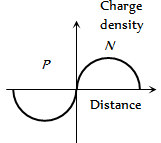
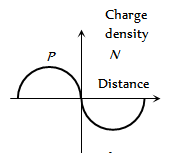
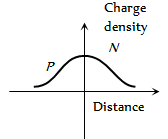
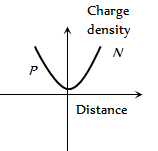
The curve between charge density and distance near P-N junction will be
  • B
  • C
  • D

Answer

Correct option: A.

Need a full question paper?

Generate a complete, print-ready paper with questions like this in minutes — across 16+ boards, with answer keys.

Start Generating Free

Similar questions

In a Young’s double slit experiment, the slit separation is $0.2\, cm$, the distance between the screen and slit is $1\,m$. Wavelength of the light used is $5000 Å.$ The distance between two consecutive dark fringes (in $mm$) is
Consider a current carrying wire $($current $I)$ in the shape of a circle.
In a PNP transistor the base is the N-region. Its width relative to the P-region is
Two identical induction coils each of inductance $L$ joined in series are placed very close to each other such that the winding direction of one is exactly opposite to that of the other, what is the net inductance
If a source of electromagnetic radiation having power $15 kW$ produces $10^{16}$ photons per second, the radiation belongs to a part of spectrum is.(Take Planck constant $h =6 \times 10^{-34}\,Js$ )
Two small spheres each having the charge $ + Q$ are suspended by insulating threads of length $L$ from a hook. This arrangement is taken in space where there is no gravitational effect, then the angle between the two suspensions and the tension in each will be
A uniform conducting wire of length $12 \mathrm{a}$ and resistance $'R'$ is wound up as a current carrying coil in the shape of,

$(i)$ an equilateral triangle of side $'a'.$

$(ii)$ a square of side $'a'.$

The magnetic dipole moments of the coil in each case respectively are:
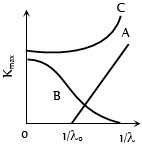
The correct graph between the maximum energy of a photoelectron and the inverse of wavelength of the incident radiation is given by the curve
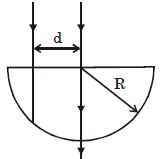
As shown, a narrow beam of light is incident onto a semi-circular glass cylinder of radius $R.$ Light can exit the cylinder when the beam is at the centre. When the beam is moved parallarly to a distance $d$ from the central line, no light can exit the cylinder from its lower surface. Find the refractive index of the glass.
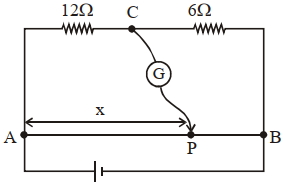
Consider a $72\, cm$ long wire $AB$ as shown in the figure. The galvanometer jockey is placed at $P$ on $A B$ at a distance $x cm$ from $A$. The galvanometer shows zero deflection.

The value of $x,$ to the nearest integer, is ..... $cm$