Question
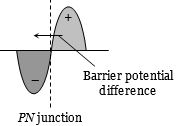
The curve between charge density and distance near $P-N$ junction will be
Answer

(a)In the depletion layer of $PN$ junction, stationary, positive ions exists in the $ N-$ side and stationary negative ions exists in the $P $ side.

Need a full question paper?

Generate a complete, print-ready paper with questions like this in minutes — across 16+ boards, with answer keys.
Start Generating Free

Similar questions

If $n, e, \tau$ and $m$ are representing electron density, charge, relaxation time and mass of an electron respectively, then the resistance of a wire of length / and cross-sectional area $A$ is given by
A particle of mass $m$ at rest is acted upon by a force $F$ for a time $t$. Its Kinetic energy after an interval $t$ is
Force of attraction between the plates of a parallel plate capacitor is
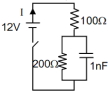
Find the charge in steady state of the capacitor. (in $nC)$
The ends of two rods of different materials with their thermal conductivities, radii of cross-sections and lengths all are in the ratio $1:2$ are maintained at the same temperature difference. If the rate of flow of heat in the larger rod is $4\;cal/\sec $, that in the shorter rod in $cal/\sec $ will be
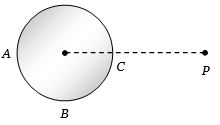
A hollow conducting sphere is placed in an electric field produced by a point charge placed at $P$ as shown in figure. Let ${V_A},{V_B},{V_C}$ be the potentials at points $A,B$ and $C$ respectively. Then
A thin and uniform rod of mass $M$ and length $L$ is held vertical on a floor with large friction. The rod is released from rest so that it falls by rotating about its contact-point with the floor without slipping. Which of the following statement($s$) is/are correct, when the rod makes an angle $60^{\circ}$ with vertical ? [ $g$ is the acceleration due to gravity]

$(1)$ The radial acceleration of the rod's center of mass will be $\frac{3 g }{4}$

$(2)$ The angular acceleration of the rod will be $\frac{2 g }{ L }$

$(3)$ The angular speed of the rod will be $\sqrt{\frac{3 g}{2 L}}$

$(4)$ The normal reaction force from the floor on the rod will be $\frac{ Mg }{16}$

Which of the following function represents a simple harmonic oscillation
An isosceles glass prism with base angles $40^{\circ}$ is clamped over a tray of water in a position such that the base is just dipped in water. A ray of light incident normally on the inclined face suffers total internal reflection at the base. If the refractive index of water is $1.33$, then the condition imposed on the refractive index $\mu$ of the glass is
If the angular momentum of an electron is $\vec J$ then the magnitude of the magnetic moment will be