MCQ
The de-Broglie wavelength $\lambda$ associated with an electron having kinetic energy $E$ is given by the expression
  • $\frac{h}{\sqrt{2 m E}}$
  • B
    $\frac{2 h}{m E}$
  • C
    $2\ m h E$
  • D
    $\frac{2 \sqrt{2 m E}}{h}$

Answer

Correct option: A.
$\frac{h}{\sqrt{2 m E}}$
$\frac{1}{2} m v^2=E \Rightarrow m v=\sqrt{2 m E} ; $
$\therefore \lambda=\frac{h}{m v}=\frac{h}{\sqrt{2 m E}}$

Need a full question paper?

Generate a complete, print-ready paper with questions like this in minutes — across 16+ boards, with answer keys.
Start Generating Free

Similar questions

A particle starting from rest travels a distance $x$ in first 2 seconds and a distance $y$ in next two seconds, then
A particle $P$ moving with speed $v$ undergoes a head -on elastic collision with another particle $Q$ of identical mass but at rest. After the collision
A spherical drop of water has radius $1 \mathrm{~mm}$ if surface tension of water is $70 \times 10^{-3} \mathrm{~N} / \mathrm{m}$ difference of pressures between inside and out side of the spherical drop is
Which of the following waves have the maximum wavelength
If a convex lens of focal length $80 \mathrm{~cm}$ and a concave lens of focal length $50 \mathrm{~cm}$ are combined together, what will be their resulting power
A rectangular block is $5 cm \times 5 cm \times 10 cm$ in size. The block is floating in water with $5 cm$ side vertical. If it floats with $10 cm$ side vertical, what change will occur in the level of water?
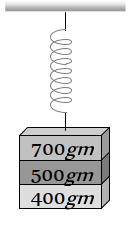
Three masses $700 g , 500 g$, and $400 g$ are suspended at the end of a spring a shown and are in equilibrium. When the $700 g$ mass is removed, the system oscillates with a period of 3 seconds, when the $500 gm$ mass is also removed, it will oscillate with a period of
Image
A car of mass $1000 \mathrm{~kg}$ accelerates uniformly from rest to a velocity of $54 \mathrm{~km} /$ hour in $5 \mathrm{~s}$. The average power of the engine during this period in watts is (neglect friction)
A small block slides without friction down an inclined plane starting from rest. Let $S_n$ be the distance travelled from time $t=n-1$ to $t=n$. Then $\frac{S_n}{S_{n+1}}$ is
The power of a pump, which can pump $200 \mathrm{~kg}$ of water to a height of $200 \mathrm{~m}$ in $10 \mathrm{sec}$ is $\left(g=10 \mathrm{~m} / \mathrm{s}^2\right)$